The Art and Science of the Spoke: Why Wheel Building Needs a Digital Twin
Why traditional wheel building is failing modern carbon rims, and how digital twin technology is bringing 0.1mm precision to the workshop.
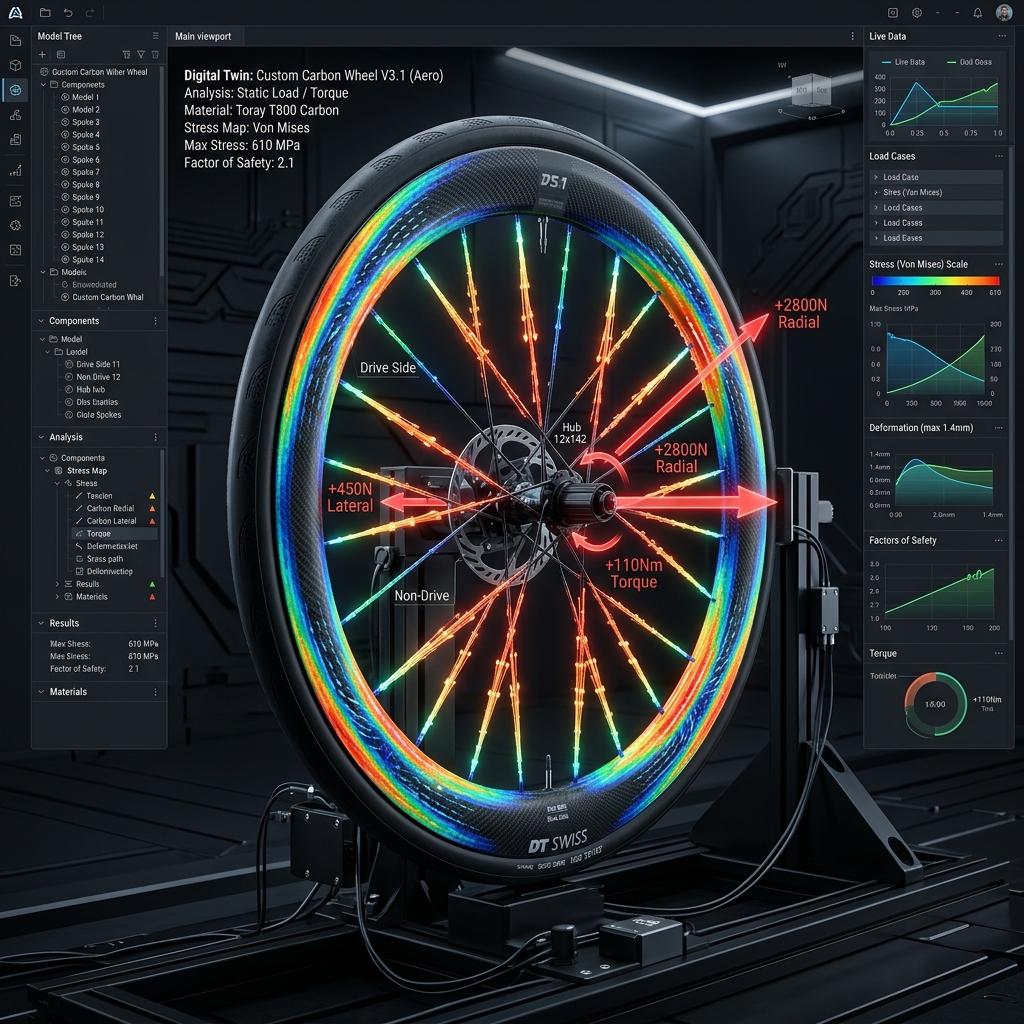
To the casual observer, a bicycle wheel is a simple machine. To an engineer, it is one of the most elegant pre-stressed structures ever designed. It is a dynamic system in constant tension, where every component is interdependent. If one spoke loses tension, the entire structure deforms.
This interdependence is why wheel building has traditionally been treated as a “black art.” Experienced builders talk about the “ping” of a spoke or the “feel” of the truing stand. But this artisanal approach is reaching its breaking point. Modern equipment — high-modulus carbon, aerodynamic profiles, disc brakes — has changed the physics. The margin for error has vanished.
Why Traditional Formulas are Failing
If you ask an old-school builder how they calculate spoke length, they’ll likely point you to a static formula derived in the 1970s. This formula works fine for box-section aluminum rims and heavy, constant-gauge steel spokes — but it ignores the Material Dynamics of modern racing equipment.
The Three Failure Modes of Static Math
| Variable | The Challenge | The Impact |
|---|---|---|
| Spoke Elongation | Modern thin-gauge spokes stretch significantly under 130kgf. | Spokes end up 1-2mm too long, bottoming out nipples. |
| Rim Compression | Carbon rims “shrink” slightly toward the center under load. | Reduces the Effective Rim Diameter (ERD) mid-build. |
| Cross-Interference | 3-cross patterns cause spokes to bend around each other. | Adds non-linear length to the path that static math misses. |
The Digital Twin Solution
At ThinkAram, we believe the solution is the Digital Twin. Instead of just calculating a number, our Spoke Calculator creates a virtual model of the wheel’s physics, treating the wheel as a functional system — not a static object.
Parametric Precision in the Workshop
- Phase 1 (Design): We ingest the exact geometry of the hub and rim.
- Phase 2 (Simulation): The physics engine simulates the tension load. It predicts the “Dish” (asymmetry) and calculates the exact tension ratio between drive-side and non-drive-side.
- Phase 3 (Validation): As the builder works, they enter real-world tension readings. If readings deviate from the simulation, the Digital Twin highlights the error before the build is finalized.
KEY INSIGHT: A Digital Twin isn’t just a calculator; it’s a Verification Engine that ensures the physical build matches the engineering theory — every single time.
Why 0.1mm Matters: The Fatigue Environment
You might ask: “Does 0.1mm really matter on a bicycle?” In a static environment, no. But a bicycle wheel is a dynamic fatigue environment. A wheel rotating at 30mph undergoes roughly 400 load cycles per minute. Over a 5-hour ride, every spoke is loaded and unloaded thousands of times.
- If too short: The nipple doesn’t have full thread engagement, leading to “stripping” under peak torque (sprinting/climbing).
- If too long: The spoke can protrude through the rim tape, causing mysterious punctures or preventing the final tension required for a responsive, performance wheel.
Summary: Engineering the Future of Wheel Building
The Industrialization of Choice means we are moving from a world of “good enough” to a world of Quantified Quality. Whether it’s an Olympic track bike or a daily commuter, the same logic applies: optimization through high-fidelity data.
Key takeaways:
- Static formulas fail modern materials: Elongation, compression, and cross-interference require a dynamic model.
- Digital Twins verify, not just calculate: Every build is validated against a live physics simulation.
- 0.1mm is the difference: Between a road-ready wheel and a failure point under load.
- Every build improves the model: Data from each wheel refines the global simulation collectively.
Q&A
Q: How does the Digital Twin handle different spoke materials? A: Our system includes a material database that accounts for the modulus of elasticity of various alloys and carbon composites, adjusting the expected elongation during the simulation phase.
Q: Can I use the Spoke Calculator for standard aluminum builds? A: Absolutely. While essential for high-end carbon, the precision gains apply to all materials — preventing the “settling” common in standard builds that usually requires a full retruing after the first 100 miles.