Generative Design: Optimizing Cycling Components
How we used cloud-based generative design in Autodesk Fusion 360 to engineer a lighter, stiffer rear dropout component for track racing.
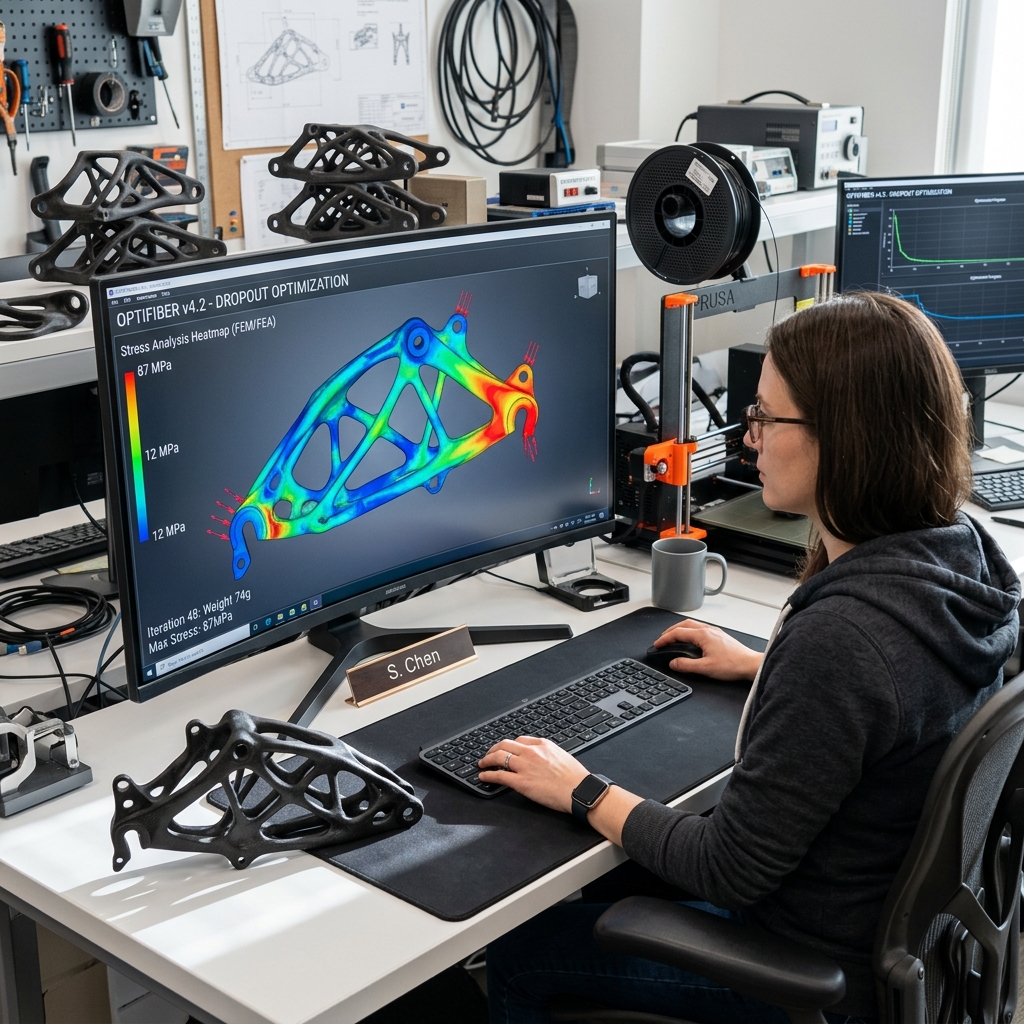
Traditional manufacturing teaches us to design within the bounds of human intuition. We draw straight lines, uniform wall thicknesses, and standard geometric shapes because they are easy to visualize and machine.
But nature does not use straight lines. By using cloud-based generative design algorithms, we let physics dictate the form. This post explains how we optimized a critical structural junction — the rear track dropout — to achieve maximum stiffness with minimum material weight.
The Challenge of the Rear Dropout
The rear dropout of a track bicycle is a high-stress component. It must withstand the massive chain tension generated by Olympic sprinters, support wheel clamping forces, and maintain perfect alignment under high cornering loads.
Using traditional manufacturing, making this component stiffer meant adding material, which increased weight. Our goal was to find a design that reduced weight without compromising the structural integrity needed for elite competition.
KEY TAKEAWAY: Traditional CAD design often results in over-engineered, heavy components because human designers tend to rely on static safety factors rather than algorithmic optimization.
Defining Boundary Conditions and Constraints
To initiate the generative design process in Fusion 360, we did not draw a finished part. Instead, we defined the spatial and physical requirements of the system:
- Preserve Geometries: We specified areas that must remain untouched, such as the axle slot, wheel interface, and frame mounting points.
- Obstacle Geometries: We designated areas where the algorithm could not build material, ensuring clearance for the chain, hub, and tool access.
- Loads and Forces: We inputted real-world physical vectors, including a 1,500-watt sprinter’s chain pull and lateral cornering forces.
- Manufacturing Methods: We limited the algorithm’s output to methods we could actually execute: 3-axis CNC milling and metal additive manufacturing.
Selecting the Optimal Design Outcome
The algorithm generated dozens of valid solutions based on different material configurations and manufacturing techniques. The resulting models looked organic, resembling bone structures with hollowed pathways where stress was minimal.
By evaluating the stress distributions and weight metrics, we selected a hybrid design that we could machine from a solid block of aerospace-grade aluminum. The finished part was 30% lighter than our previous version while increasing lateral stiffness by 15%.
Summary: Algorithmic Engineering in Practice
Generative design allows engineers to explore hundreds of design iterations in hours, pushing past the limits of traditional design workflows.
Key takeaways:
- Let physics define the shape: Define the load paths and clearances, and let the software compute the structure.
- Synthesize manufacturing limits: Restricting the algorithm to specific fabrication options ensures the results can actually be built.
- Significant weight reduction: Algorithmic optimization regularly achieves weight savings that human designers miss.
Q&A
Q: Is generative design only useful for 3D printing? A: No. Fusion 360 allows you to set manufacturing constraints for CNC milling, casting, and 2-axis cutting, producing shapes optimized for standard machinery.
Q: How do you verify the algorithm’s structural claims? A: We run the selected geometry through independent Finite Element Analysis (FEA) in Ansys to validate the stress and displacement predictions.