Ansys Level Up 2.0: Simulation-First Workflows for Startups
How small hardware startups can leverage Ansys simulation programs to decrease R&D costs and accelerate product validation loops.
For startup hardware companies, cash flow and speed to market are the ultimate constraints. Testing physical prototypes to destruction in third-party labs is incredibly expensive and slow. A single failed certification test can exhaust a startup’s entire R&D budget.
In our presentation at Ansys Level Up 2.0, we discussed how the Ansys Startup Program allowed us to establish a Simulation-First engineering culture. This approach helped us build complex composite structures that passed laboratory certification on their first physical attempt.
The Budget Trap of Physical Prototyping
Startups traditionally design a part, build a physical prototype, ship it to a testing facility, and wait for the results. If it fails, they must guess where the structural weakness was, rebuild, and retest.
This loop has several major disadvantages:
- High Unit Costs: Low-volume prototype manufacturing is slow and expensive.
- Blind Failures: Physical break tests only tell you when a part broke, not how the internal stress paths developed immediately prior.
- Limited Variations: High costs restrict the design team to testing only one or two design choices, preventing true optimization.
KEY TAKEAWAY: Relying solely on physical testing to find structural weaknesses is a high-risk strategy that exhausts budgets and forces conservative engineering compromises.
Building a Digital Test Lab
At Level Up 2.0, we explained how we use Ansys tools to build a virtual test environment on our local workstations. This digital lab replicates official ISO and Olympic certification procedures.
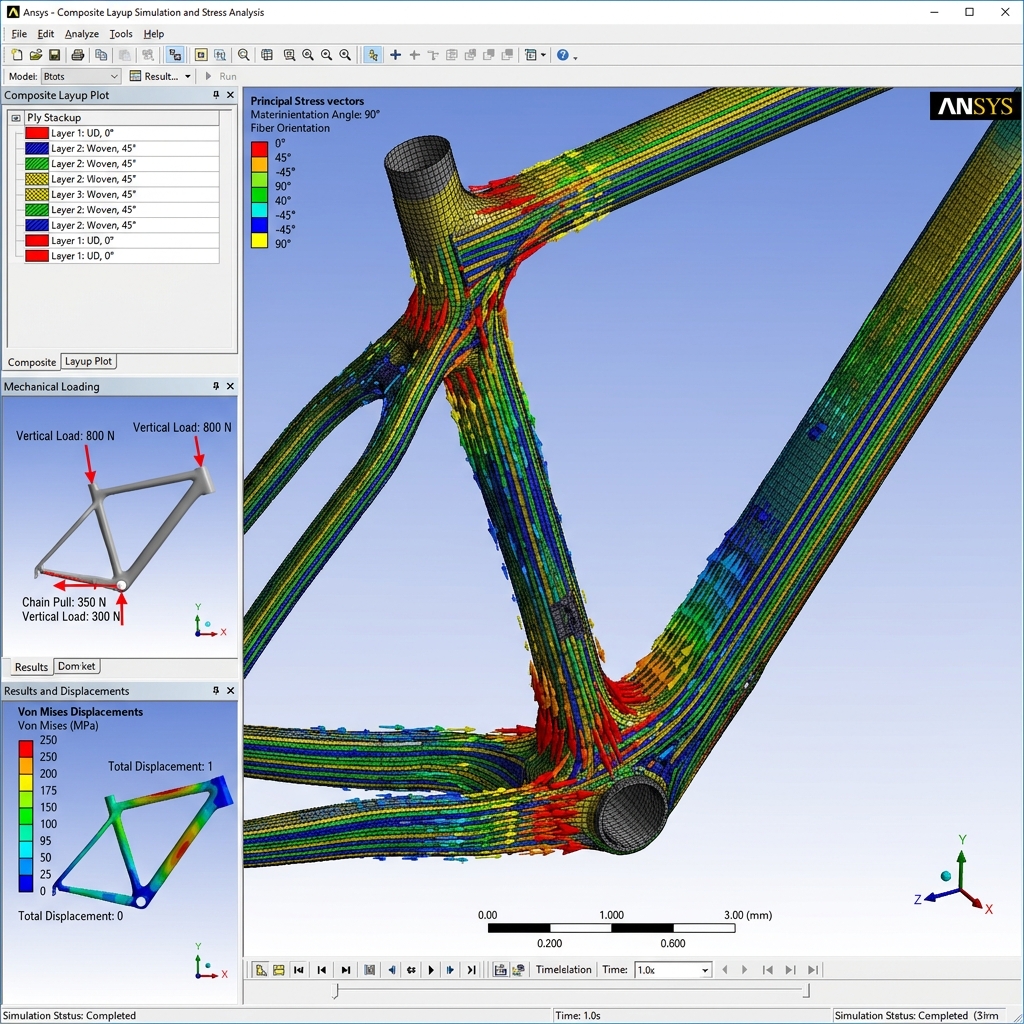
We simulated standard fatigue tests (compressing the frame head tube under cyclic loads) and impact tests (simulating a high-speed collision). Because the analysis is virtual, we could inspect the stress patterns at any coordinate inside the carbon laminate, identifying hidden ply shear issues.
Compressing R&D from Months to Weeks
By moving our validation to the computer, we optimized dozens of design parameters concurrently. We varied frame wall thicknesses, altered fiber orientations, and tested different grade resins in hours instead of weeks.
This simulation-first process saved us at least seven to eight months of physical R&D time for the RF20 track frame development. When we finally manufactured the physical frame and submitted it to the lab, it passed all ISO testing criteria on the first run.
Summary: Leveling the Engineering Playing Field
Access to advanced simulation tools allows small manufacturing startups to achieve the design optimization and validation speeds of major aerospace manufacturers.
Key takeaways:
- Test virtually first: Run structural fatigue and impact tests digitally to resolve failure modes early.
- Inspect the invisible: Use FEA to visualize internal shear stresses that cannot be seen in physical lab testing.
- Pass on the first run: Thorough simulation ensures that physical testing is a final validation step rather than a guessing game.
Q&A
Q: How did you get access to these enterprise tools as a startup? A: We joined the Ansys Startup Program, which offers discounted software licenses and technical support to early-stage engineering firms.
Q: What is the biggest challenge when moving to a simulation-first workflow? A: Ensuring model accuracy. Your simulation results are only as good as your material data input and boundary condition setup. We spent months correlating early simulations with physical load cell readings.