SIGGRAPH 2021: Real-Time Rendering in the Omniverse
How we used NVIDIA Omniverse and Material Definition Language to render photorealistic carbon fiber textures and reflections in real time.
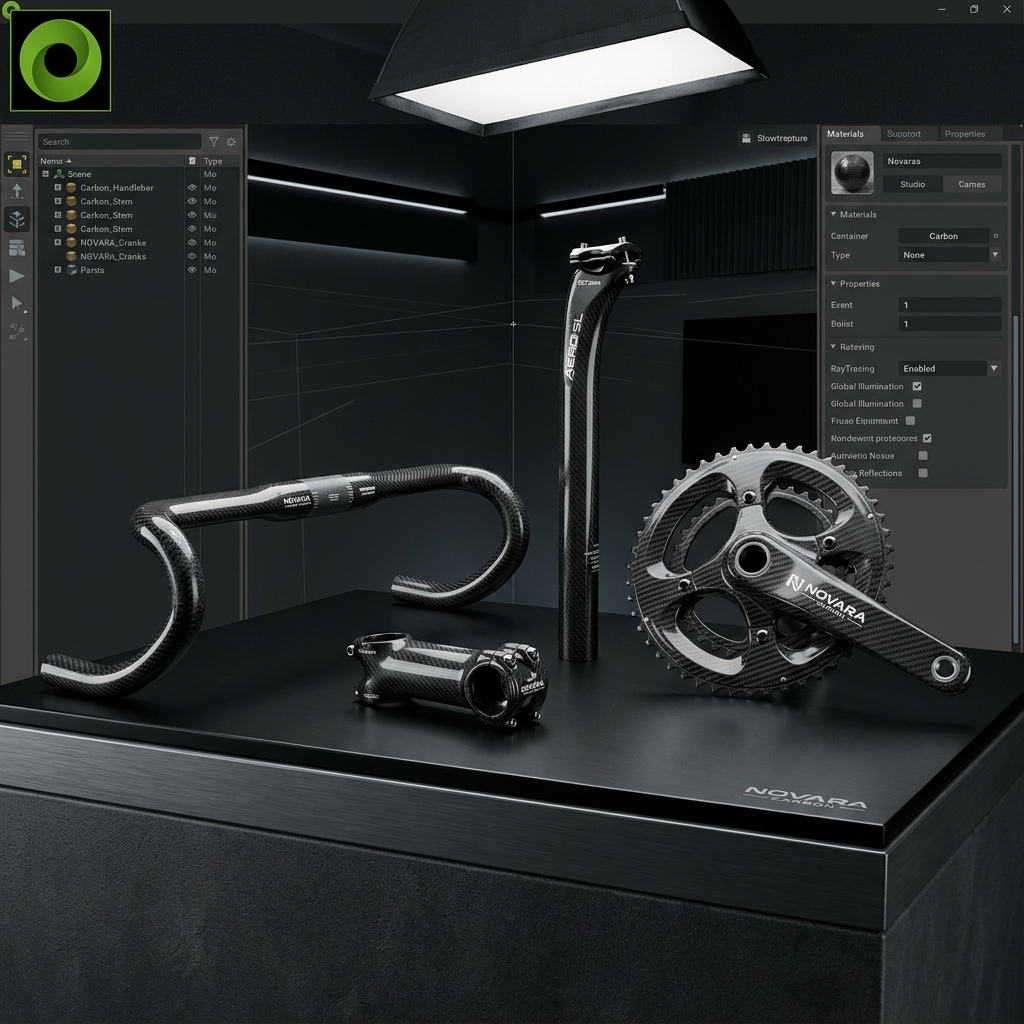
Carbon fiber is a difficult material to render accurately in traditional CAD viewers. Its surface is not just a dark color; it is a complex, multi-layered weave of reflective fibers suspended in a clear epoxy resin.
Under light, the direction of the reflection shifts dynamically depending on the angle of the weave, creating a unique visual depth (anisotropy). This post covers our SIGGRAPH 2021 panel discussion, detailing how we used NVIDIA Omniverse to solve this rendering challenge and run photorealistic design reviews in real time.
The Challenge of Anisotropic Surfaces
Traditional CAD rendering engines rely on simplified shaders that treat carbon fiber as a static 2D texture map. This approach looks flat and fails to capture how light actually refracts through the clear resin coat and bounces off the metallic carbon strands.
In the design phase of custom products, this visual inaccuracy causes problems. We could not show clients how different weave patterns (e.g., 3K twill vs. unidirectional spread-tow) would look under natural lighting conditions without rendering high-end offline sequences, which took hours per frame.
KEY TAKEAWAY: Inaccurate visual rendering forces teams to build cosmetic mockups, adding material waste and slowing design approval loops.
Defining Real Materials with MDL
At SIGGRAPH 2021, we explained how NVIDIA Omniverse’s support for Material Definition Language (MDL) solves this visual rendering gap. MDL allows us to define the actual physical properties of the carbon/resin matrix:
- Subsurface Scattering: We modeled how light penetrates the outer epoxy coat and diffuses through the underlying fibers.
- Dual-Lobe Specularity: We defined two separate reflective layers — a sharp reflection from the smooth outer resin and a scattered, anisotropic reflection from the woven fibers.
- Fiber Orientation Mapping: We imported the actual fiber direction vectors from our Ansys simulation models, aligning the render’s reflections with the real structural layup.
Eliminating Rendering Wait Times
By leveraging GPU RT cores and path tracing inside Omniverse, we rendered these complex MDL materials instantly. We could change the carbon weave style, modify the clear coat gloss level, and adjust environmental lighting during active design review meetings.
This computational rendering speed allowed our team to make aesthetic and engineering choices in parallel, validating the visual layout of custom composite components before commencing physical production.
Summary: High-Fidelity Design Validation
Real-time photorealistic rendering bridges the gap between mechanical engineering and aesthetic design.
Key takeaways:
- Anisotropic rendering requires MDL: Accurately depicting carbon fiber requires modeling multi-layered surface specularity.
- Connect CAD and rendering databases: Importing fiber directions from engineering files guarantees visual accuracy.
- Instant design reviews: GPU-accelerated path tracing removes rendering bottlenecks, letting you refine aesthetics live.
Q&A
Q: Can these MDL files be used in other rendering engines? A: Yes. MDL is an open standard, meaning materials defined in Omniverse can be exported and used in other compliant tools like Substance Painter, V-Ray, or Adobe Stager.
Q: Does rendering performance drop with complex assemblies? A: Because Omniverse uses Universal Scene Description (USD) and instancing, it handles massive assemblies containing millions of polygons without significant frame rate drops.