AyoWork: Digital Twin Manufacturing in the Metaverse
How we combined Autodesk Fusion 360 and NVIDIA Omniverse to build AyoWork, an open digital twin factory orchestration platform.
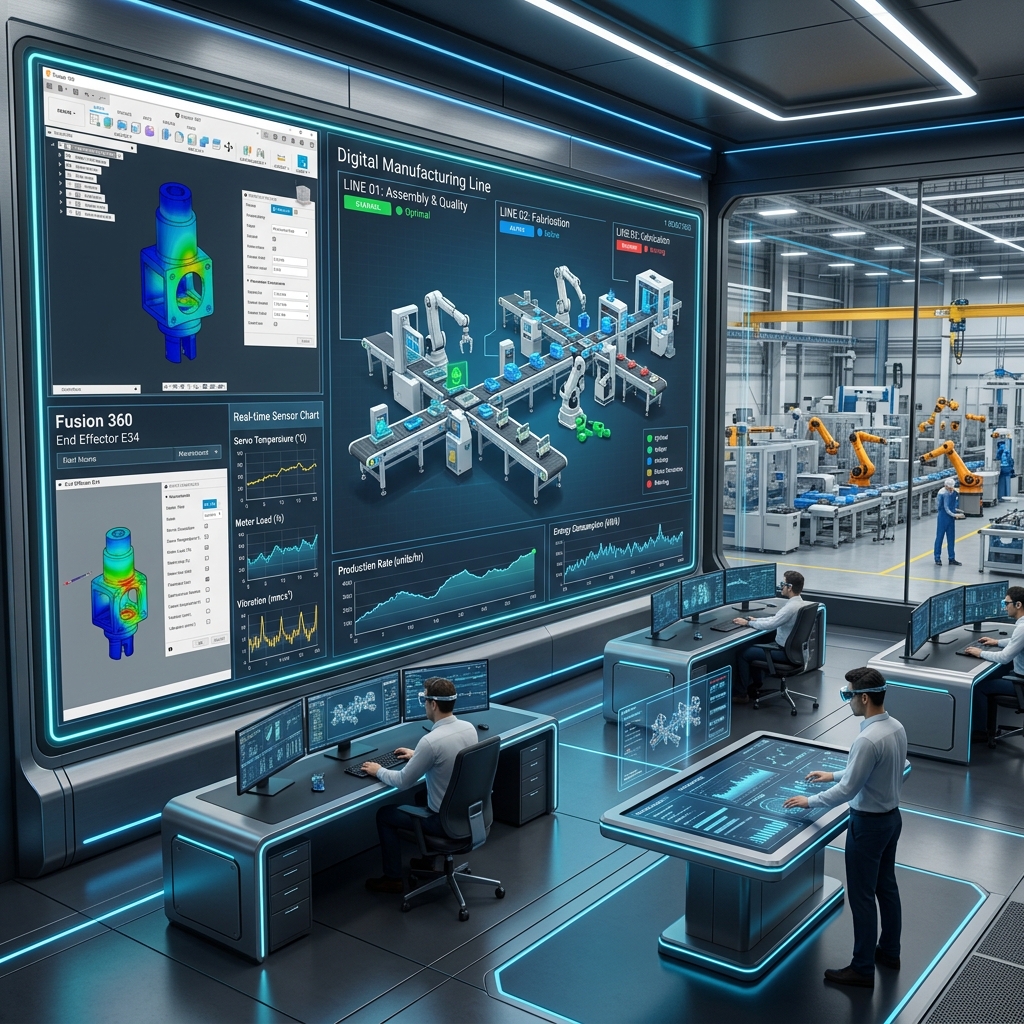
Modern factory floors are drowning in disconnected data. Machine PLCs, material tracking databases, CAD files, and employee scheduling tools all live in separate databases. Operators are forced to manually cross-reference these systems to resolve basic scheduling conflicts.
At Autodesk University 2022, we shared how we built AyoWork, a digital twin orchestration platform that unifies this data. By connecting CAD models, real-time sensor streams, and virtual layouts, we created a single virtual dashboard to manage physical manufacturing processes.
Table of contents
- The Challenge of Siloed Factory Information
- AyoWork: Unifying Software and Hardware Data
- Building the Metaverse Factory Floor
- Summary: The Future of Factory Management
The Challenge of Siloed Factory Information
In high-mix, low-volume manufacturing (like custom carbon fiber laying), flexibility is critical. But that flexibility requires real-time coordination.
When database platforms are disconnected, several inefficiencies arise:
- Invisible Bottlenecks: If a CNC mold-cutting machine experiences a tool failure, the schedule coordinator might not know until they notice parts aren’t arriving.
- Disconnected Assembly Models: Operators looking at a paper assembly guide cannot see if a component design was modified in CAD hours earlier.
- Wasted Floor Space: Without physical factory simulations, configuring a new workbench layout is a guessing game that disrupts production.
KEY TAKEAWAY: The true value of a digital twin is not just 3D visualization; it is the unification of operational databases with geometric CAD models.
AyoWork: Unifying Software and Hardware Data
In our AU 2022 presentation, we showed how AyoWork uses Fusion 360 and NVIDIA Omniverse to build a live-updating factory model.
- Geometric Source of Truth: Fusion 360 houses the mechanical models of our products and shop floor equipment.
- Operational Sync: We link these models to physical factory machinery using MQTT and OPC-UA sensor streams.
- Central Visual Viewport: Omniverse runs the real-time layout rendering, displaying live machine statuses (e.g., green for running, red for fault) directly on the 3D models.
Figure 1: AyoWork digital twin workspace displaying real-time manufacturing metrics.
Building the Metaverse Factory Floor
By combining these tools, we created a virtual workspace where teams can coordinate assembly lines. Operators can inspect machine load levels, check raw material inventory locations, and simulate assembly workflows before making physical changes on the shop floor.
This system has changed how we manage our composite manufacturing, reducing setup times for new component runs and ensuring that physical work matches the latest CAD revisions.
Summary: The Future of Factory Management
Orchestrating factory data via a digital twin dashboard improves coordination and throughput for custom manufacturing teams.
Key takeaways:
- Unify CAD and operation data: Map physical sensor feeds directly onto 3D CAD assets.
- Run virtual layout tests: Simulate workspace changes to find bottlenecks before moving heavy equipment.
- Maintain a single source of truth: Connect design changes to the shop floor instantly to avoid out-of-date documentation.
Q&A
Q: What sensor standards does AyoWork support? A: AyoWork is built around open standards, utilizing MQTT for light data transmission and OPC-UA for industrial machine PLC connections.
Q: Can this scale to larger manufacturing operations? A: Yes. Because AyoWork is built on a modular, microservice-based architecture, it can scale from single custom fabrication shops to multi-site factories.