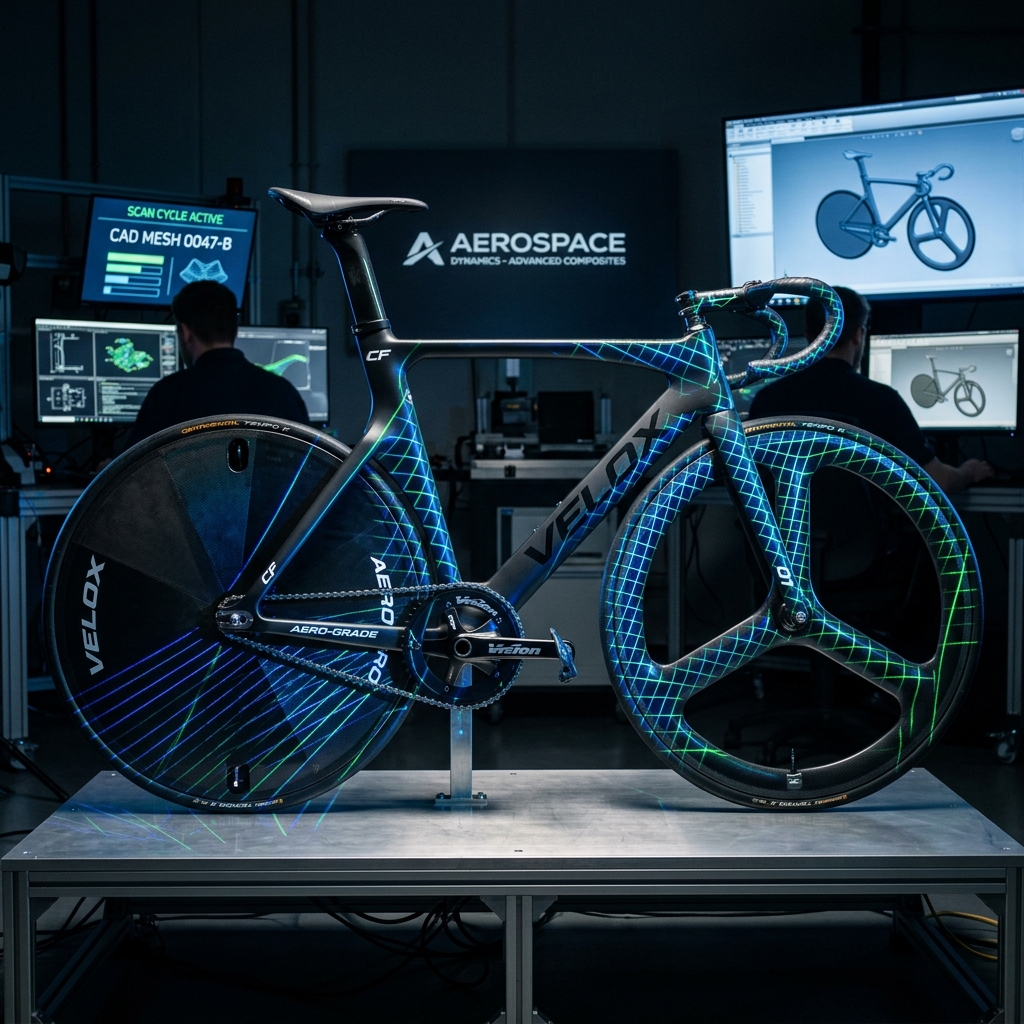
Bicycle manufacturing has spent decades substituting marketing narratives for structural physics. When I founded Predator Cycling in 2005, custom frame building was dominated by stock tube profiles, craft intuition, and empirical guesswork. I built Predator on an opposite conviction: an elite racing machine must function as an aerodynamic, biomechanical extension of the athlete, validated by first-principles mathematics before material is ever touched.
Over twenty years of engineering custom monocoque carbon fiber reinforced polymers (CFRP)—culminating in the Rio 2016 Olympic Games—that physical foundation expanded into Predator Labs (lab.predatorcycling.com). Today, the ecosystem operates as a complete physical-to-digital closed loop: bridging high-frequency FIT sensor telemetry, deterministic Rust aerodynamic physics engines, and parametric CAD Model Context Protocol (MCP) bridges to automate engineering design from athlete posture to CNC-machined mold tooling.
[ RIDER BIOMECHANICS & TELEMETRY ] ──► [ RUST PHYSICS ENGINES (Predator Labs) ]
(FIT 100Hz, Joint CV, Torso Pitch)      (Real-Time CdA, Crr, W'bal Modeling)
                │                                            │
                ▼                                            ▼
[ AI DESIGN AGENTS & RUST MCP ] ──────► [ AUTODESK FUSION / APS GRAPHQL ]
(Parametric Tree & Tolerance Audits)    (Hard CAD Geometry & Kinematic Joints)
                │                                            │
                ▼                                            ▼
[ DETERMINISTIC FEA / CFD BOUNDARIES ] ─► [ ETHERCAT / LINUXCNC 5-AXIS ROUTER ]
(Ansys Discovery & OpenUSD Solvers)       (Aluminum Compression Tooling & CFRP Layup)
Physical Heritage: 20 Years of Monocoque CFRP (Atoms)
I founded Predator Cycling in 2005 before expanding into my advanced composite manufacturing facility in Lebanon and Mount Juliet, Tennessee. From day one, my goal was to eliminate the mechanical compliance, micro-void defects, and structural disconnects of traditional bonded carbon bicycle tubes.
Custom Monocoque Fabrication & Silicone-Intensified Tooling
Rather than gluing cured tubes into lugs, I engineered continuous one-piece monocoque layups using aerospace-grade Torayca intermediate and high-modulus unidirectional pre-preg carbon fiber (T700, T800, and M46J). To solve internal compaction without relying on disposable nylon bladders that leave resin pools, I pioneered silicone-intensified compression molding.
By casting elastomeric silicone core mandrels matched to internal frame geometry, I harness volumetric thermal expansion during the autoclave and oven cure cycle:
Because the linear coefficient of thermal expansion of silicone () dwarfs that of the surrounding billet 6061-T6 aluminum mold cavity (), elevating the tool temperature to () generates sustained internal consolidation pressure exceeding 150 psi. This hydrostatic expansion evacuates trapped volatiles, consolidates the laminate, and drives void content below .
“The Major” Cockpit & The Rio 2016 Olympic Games
In 2011, I introduced “The Major”—a monolithic, integrated carbon handlebar and stem system designed to withstand track sprinters producing over 2,500 watts of explosive torque. By eliminating the mechanical stem faceplate and bolted clamp, “The Major” removed the primary failure mode and compliance vector of competitive cockpits.
Two-time US Olympian Bobby Lea selected a bespoke edition of “The Major” for the Rio 2016 Olympic Games track omnium. Rigorous torsional rig validation demonstrated a 34% increase in steering stiffness alongside superior structural vibration damping over 250-meter wood velodromes.
The RF20 Road Frame: Simulation-First Aerodynamics
In 2018, I designed the RF20 road frame as the first production bicycle created entirely within a real-time GPU simulation environment. Utilizing Ansys Discovery and NVIDIA RTX acceleration, I evaluated more than 500 aerodynamic and structural variations in days—optimizing leading-edge transitions where the fork crown integrates into the down tube, reducing wake turbulence across the rider’s lower limbs while maintaining compliance across long-endurance courses.
The 5D Methodology: Factory Operating System
To scale custom composite fabrication while maintaining aerospace-grade traceability, I codified the 5D Manufacturing Methodology:
- Design: Transitioning from static drawings to fully parametric constraint networks in Autodesk Fusion, linking athlete coordinates directly to CAD geometry.
- Develop: Replacing physical trial-and-error scrap with deterministic FEA/CFD boundaries, stress-testing failure criteria under Tsai-Wu and Hashin composite damage models.
- Data Log: Provisioning an immutable digital birth certificate (GUID) to each pre-preg roll, cure thermal profile, and technician touchpoint.
- Drive: Validating digital twins against on-road telemetry, measuring live strain-gauge deflection and power losses on calibrated test mules.
- Deliver: Exporting serialized inspection reports, spoke tension certificates, and digital twin assets directly to the customer and enterprise ERP.
This methodology proved that small, agile engineering firms can surpass multi-national mass manufacturers by replacing manual drafting with software-defined engineering pipelines.
Predator Labs: Computational Cycling & Physics Solvers (Bits)
While Predator Cycling establishes the physical manufacturing mastery, Predator Labs (lab.predatorcycling.com) serves as my digital intelligence hub, athlete operating system, and engineering studio. I recognized that designing custom aerodynamic cockpits and carbon layups cannot begin with aesthetic sketches—it must begin with real-time computational biomechanics and physics telemetry.
Predator Labs operates three core production subsystems:
- High-throughput Rust aerodynamic and resistance solvers.
- High-frequency FIT telemetry processing and computer-vision pose estimation.
- Rust-accelerated Parametric CAD Model Context Protocol (MCP) design agents.
+-----------------------------------------------------------------------------------+
|                        PREDATOR LABS ARCHITECTURE                                  |
|                                                                                   |
|  [ Field Telemetry Streams ]          [ Biomechanical Pose Stream ]               |
|  - 100 Hz FIT Power / Cadence          - Computer Vision Joint-Angle Tracking     |
|  - Micro-Barometer Airspeed            - Torso Pitch & Frontal Area Estimation    |
|              │                                       │                            |
|              ▼                                       ▼                            |
|  +─────────────────────────────────────────────────────────────────────────────+  |
|  |           DETERMINISTIC RUST ENGINE (Sub-Millisecond Execution)             |  |
|  |  - Aerodynamic Drag Solver (CdA)      - Rolling Resistance Solver (Crr)     |  |
|  |  - Anaerobic Capacity Engine (W'bal)  - Multi-Surface Physics Calibration   |  |
|  +─────────────────────────────────────────────────────────────────────────────+  |
|                                      │                                            |
|                                      ▼                                            |
|  +─────────────────────────────────────────────────────────────────────────────+  |
|  |            RUST MCP PARAMETRIC BRIDGES (Model Context Protocol)             |  |
|  |  - Autodesk Platform Services (APS) GraphQL Graph Verification               |  |
|  |  - Bearing Bore & Tolerance Audits (ISO H7/p6 Press-Fits)                   |  |
|  |  - Automated Ansys / OpenUSD Mechanical Simulation Gate                     |  |
|  +─────────────────────────────────────────────────────────────────────────────+  |
|                                      │                                            |
|                                      ▼                                            |
|  [ Physical Factory Floor: EtherCAT / LinuxCNC 5-Axis Carbon Mold Router ]        |
+-----------------------------------------------------------------------------------+
High-Throughput Rust Physics & Aerodynamic Solvers
Competitive cycling dynamics operate under strict conservation of energy governed by the classic power balance equation:
Where represents effective frontal drag area, is the tire-surface rolling resistance coefficient, is air density dynamically corrected for barometric pressure and temperature, is gradient, and is all-up system mass.
The Rust Migration: Eliminating GC Latency Spikes
My early physics solvers ran on Python and Node.js. However, processing continuous, multi-hour 100 Hz sensor streams while performing iterative non-linear regressions to isolate aerodynamic drag from rolling resistance caused garbage collection pauses, dropped packets, and unacceptable solver latency.
I migrated these core physics microservices to Rust, achieving:
- ~4.8x+ Throughput Acceleration: Sub-millisecond calculation of instantaneous drag area across varying yaw angles.
- Deterministic Memory Safety: Zero runtime garbage collection pauses during live race telemetry decoding.
- W’bal Dynamic Depletion Engines: Real-time modeling of anaerobic work capacity expenditure and exponential recovery rates:
This engine empowers athletes and coaches to pinpoint precisely when anaerobic reserve is depleted during tactical attacks, providing empirical data to optimize cockpit hand positions and torso drop angles.
FIT Telemetry Analytics & Biomechanical Pose Estimation
To ground parametric CAD in empirical rider data, Predator Labs automates the ingestion of standard Garmin and Wahoo FIT binary activity files:
- High-Frequency Stream Parsing: Streaming decoding of 100 Hz accelerometer, pedal force vectoring, heart rate, and cadence channels.
- Computer-Vision Joint Angle Tracking: Processing high-speed video to extract planar biomechanical joint coordinates (hip angle, knee flexion/extension, ankle canting, and torso inclination angle).
- Interactive WebGL 3D Cockpit Configurator: Real-time 3D browser representation mapping rider anthropometric proportions to custom handlebar drops, reach offsets, and elbow flare angles.
By correlating changes in rider torso pitch with instantaneous measurements calculated by my Rust solvers, the system identifies the exact threshold where an aerodynamic position begins restricting lung ventilation and diaphragmatic power generation.
Rust-Accelerated Parametric CAD MCP Tooling
The crowning layer of the Predator Labs ecosystem is my custom Rust Model Context Protocol (MCP) bridge connecting generative AI design agents directly to engineering CAD environments.
Foundation LLMs are notoriously illiterate at physics and manufacturing constraints. If asked to design a carbon stem, an unconstrained model will hallucinate self-intersecting B-spline surfaces, zero-thickness shells, and un-machinable internal cavities.
Closing the Loop with Model Context Protocol
My Rust MCP service exposes the Autodesk Fusion API and Autodesk Platform Services (APS) GraphQL schemas as strongly typed agent tool contracts:
- Parametric Feature Tree Verification: AI design agents query the parametric timeline, enforcing non-destructive geometric operations, minimum draft angles () for composite demolding, and fillet radii () to mitigate structural stress risers.
- COTS Hardware & Tolerance Audits: Automated checks enforce precision tolerances for bearing bores (e.g., ISO H7 clearance for headset bearings and p6 interference for press-fit bottom brackets), ensuring hardware mates seamlessly without post-cure hand machining.
- FEA/CFD Simulation Gates: Before geometry is approved for CNC milling, the MCP server passes the boundary mesh to Ansys Discovery and OpenUSD simulation kernels. If maximum von Mises stress or first-ply failure margins exceed allowable safety factors (), the solver returns a typed error vector directly to the design agent, driving iterative geometric refinement until convergence.
- Direct-to-Machine Toolpathing: Validated molds are exported directly into CAM operations, posting G-code over EtherCAT to LinuxCNC-controlled 5-axis routers.
For an in-depth analysis of why ungrounded models fail and how I enforce mathematical boundaries, read my essay on Physics as Code: Why Foundation Models Fail Without First-Principles Constraints.
Technical Notes & Field Q&A
Why rewrite cycling physics and aerodynamic solvers in Rust instead of keeping Python/NumPy?
Python with NumPy is outstanding for offline batch analysis, but fails in low-latency production pipelines. When processing 100 Hz dual-sided power meter telemetry alongside micro-barometer wind speed feeds, Python's Global Interpreter Lock (GIL) and non-deterministic garbage collection introduce latency jitter. Migrating to Rust delivered a ~4.8x+ speedup, sub-millisecond execution, zero-copy deserialization of binary FIT packets, and strict concurrency safety when running simultaneous Monte Carlo CdA simulations across multiple yaw angles.
How does silicone-intensified compression molding eliminate internal composite voids without an autoclave?
Traditional out-of-autoclave manufacturing relies on vacuum pressure alone, which caps maximum compaction at atmospheric pressure (14.7 psi) and often leaves interstitial voids between plies. Silicone-intensified compression molding leverages the large volumetric thermal expansion coefficient of silicone mandrels relative to CNC-machined 6061-T6 aluminum mold tooling. As the assembly heats to the 250°F (121°C) resin cure plateau, the constrained silicone core generates hydrostatic consolidation pressure exceeding 150 psi, forcing excess resin through bleed channels and compacting laminate plies to aerospace fiber-volume fractions (>60%).
How does the Rust MCP bridge prevent AI agents from hallucinating invalid CAD models in Autodesk Fusion?
The Model Context Protocol (MCP) server acts as a deterministic boundary between the LLM and the CAD kernel. Instead of allowing an LLM to generate unstructured 3D surfaces, the Rust server exposes strictly typed tools (e.g., set_bearing_bore, adjust_stem_reach, verify_wall_thickness). The bridge queries the Autodesk Platform Services (APS) GraphQL graph and local Fusion 360 API to audit geometry against physical rules: minimum wall thicknesses (>1.2 mm), draft angles (>1.5°), and bearing press-fits. If a suggested parameter violates engineering limits or fails Ansys FEA convergence, the tool returns a typed violation vector, forcing the agent to self-correct.
How does Predator Labs sync build records with enterprise systems?
Every athlete scan, CAD iteration, spoke calculation, and cure cycle GUID is synchronized directly with AyoWork—the agentic ERP platform. This guarantees that custom frame geometry, ply layup schedules, and quality assurance certificates remain permanently queryable across the product lifecycle.
Related Systems & Research
- Spoke Calculator — Rust/WASM Wheel Tension & Deformation Solver: Explore the deterministic microservice modeling non-linear spoke elongation and high-modulus carbon rim deflection.
- AyoWork — Agentic ERP & Unified Industrial Ledger: Discover how shop-floor machine events, cure profiles, and commercial workflows synchronize in real time.
- MACC Composites — Advanced Materials & Digital Commerce: Learn how my racing composite methodologies scale into defense, aerospace, and medical device manufacturing.
- Physics as Code: Why Foundation Models Fail Without First-Principles Constraints: Architectural deep-dive into bounding probabilistic AI with deterministic physics engines.
- Ergometry, Biomechanics, and the Rio Olympic Cockpit: The origin story of “The Major” cockpit, custom cleat wedging, and velodrome biomechanics.