Dynamic WebAssembly Wheel Physics: Why Static Trigonometry Destroys Carbon Rims
Why static 1970s spoke trigonometry fails deep-section carbon rims, and how compiling a Rust solver to WebAssembly delivers 0.1mm tension accuracy.
On this page6 sectionsExpandCollapse
Nearly every web-based bicycle spoke calculator on the internet still assumes a bicycle wheel is an infinitely rigid polygon.
Plug a hub’s flange spacing, spoke count, and Effective Rim Diameter (ERD) into a classic spreadsheet or online form, and you get back a clean millimeter number calculated with the exact same static Euclidean trigonometry wheel builders used in the 1970s.
On an old 36-spoke aluminum box-section touring rim laced with thick straight-gauge stainless wire, rounding to the nearest millimeter worked fine. The aluminum rim barely compressed, and thick steel spokes barely stretched.
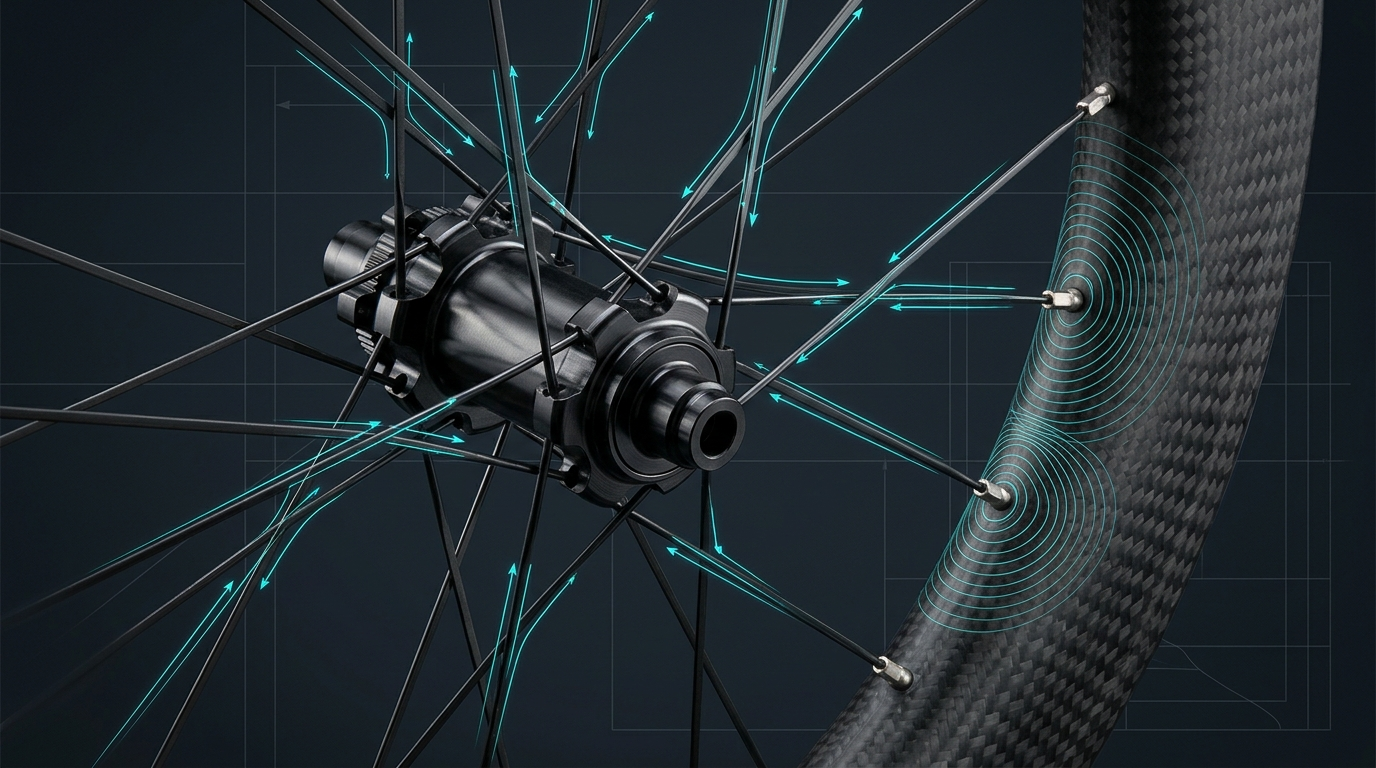
Put that same static math onto a modern 24-hole, deep-section carbon fiber racing wheel built to 130 kgf (1,275 N) using ultra-thin double-butted blades, and the wheel fights back. Spokes come out 1.0 mm to 1.5 mm too long, nipples bottom out on unthreaded spoke shanks before hitting target tension, or sharp spoke tips punch upward through tubeless rim tape mid-race.
When I built the wheel-physics engine inside Predator Labs, I replaced static trigonometry with a browser-native Rust and WebAssembly (WASM) digital twin solver calibrated to 0.1 mm precision. Here is the mechanics of why static spoke math fails modern composite rims, and how compiling deterministic Rust physics to WebAssembly bridges web UX and shop-floor quality control.
Where 1970s Euclidean Spoke Geometry Breaks Down
The textbook static spoke length formula computes a straight 3D chord between a hub flange hole and a rim spoke bed:
Where is flange offset from wheel centerline, , is spoke pitch circle radius, is cross count ( to ), and is total spoke count.
That equation makes three fatally flawed physical assumptions:
- Zero Spoke Elastic Elongation: A modern double-butted stainless steel or titanium spoke behaves like a stiff tension spring obeying Hooke’s law (). Under
130 kgfof drive-side or disc-rotor braking tension, a thin1.5 mmcenter-section spoke elongates measurably—typically0.5 mmto0.9 mm. Static geometry ignores this completely. - Infinite Rim Radial Stiffness: A carbon fiber hoop is a pre-stressed closed arch. As 24 or 28 spokes pull inward simultaneously toward the axle, the Effective Rim Diameter shrinks radially ()—often by
0.3 mmto0.8 mmdepending on carbon layup modulus and rim profile depth. - Straight-Line Crossing Paths: On a 3-cross (
3x) lacing pattern, spokes do not travel through empty air—they weave around one another at the outer crossing junction, adding non-linear arc length and friction across the deflection path.
Why 0.1 mm Precision Governs Dynamic Fatigue Life
Why obsess over tenths of a millimeter? Because a bicycle wheel is never static on the road.
At 30 mph, a 700c wheel completes roughly 400 rotations per minute—subjecting every individual spoke to 120,000 cyclic load reversals over a single five-hour endurance stage. At the bottom of each rotation, the vertical contact patch momentarily compresses the carbon hoop, causing the bottom two to three spokes to lose tension before snapping back to 120+ kgf.
- If a cut spoke is
1.0 mmtoo short: The spoke fails to engage the full thread depth inside the nipple head, concentrating cyclic shear at the neck transition until the alloy nipple snaps or strips under sprint torque. - If a cut spoke is
1.0 mmtoo long: The threaded tip runs out of nipple threads before target tension is reached, leaving an asymmetric wheel dish soft—or worse, protruding past the nipple slot to puncture tubeless tape.
| Solver Variable | 1970s Static Formula | Rust / WASM Digital Twin Solver | Precision Gain |
|---|---|---|---|
| Elastic Spoke Stretch | Ignored () | Solved via (steel, Ti, carbon moduli) | Accounts for 0.5–0.9 mm stretch at 130 kgf |
| Rim Hoop Compression | Constant nominal ERD | Coupled radial stiffness compliance under summed spoke vectors | Captures 0.3–0.8 mm radial ERD shrinkage |
| Asymmetric & Straight-Pull Hubs | Basic flange offset approximation | Full 3D coordinate vector triangulation + spoke-head seat offset | Handles dished disc & J-bend/straight-pull hubs |
| Cross-Interference | Straight Euclidean line chord | Geometric wrap arc deflection at outer crossing | Eliminates 3x lacing length drift |
| Execution Runtime | Server CGI script or basic JS math | Pure Rust compiled to wasm32-unknown-unknown | 0.1 mm accuracy in < 1 ms browser loop |
Physics as Code: Sharing One Rust Solver Between Browser and Shop Floor
Instead of duplicating wheel math between a client-side JavaScript calculator and a backend ERP validation service—where floating-point drift and inconsistent material tables silently diverge—I structured the solver around my Physics as Code invariant: write the physics crate once in Rust and compile it everywhere.
/// Coupled non-linear tension equilibrium step for one wheel side.
#[derive(Clone, Copy, Debug)]
pub struct SpokeMaterial {
    pub youngs_modulus_gpa: f64,     // e.g., 200.0 (Sandvik T302), 110.0 (Ti)
    pub effective_area_mm2: f64,     // Weighted across butted gauge transitions
}

pub fn solve_target_cut_length_mm(
    geometric_chord_mm: f64,
    crossing_arc_delta_mm: f64,
    target_tension_n: f64,
    rim_radial_compliance_mm_per_n: f64,
    spoke_count_side: usize,
    mat: SpokeMaterial,
) -> f64 {
    let raw_path = geometric_chord_mm + crossing_arc_delta_mm;

    // 1. Axial Hooke's law elongation under target build tension (N)
    let modulus_n_per_mm2 = mat.youngs_modulus_gpa * 1_000.0;
    let elastic_stretch_mm =
        (target_tension_n * raw_path) / (modulus_n_per_mm2 * mat.effective_area_mm2);

    // 2. Coupled radial rim compression from total inward spoke force
    let total_radial_load_n = target_tension_n * (spoke_count_side as f64);
    let erd_radius_delta_mm = total_radial_load_n * rim_radial_compliance_mm_per_n;

    // Subtract stretch and radial rim shrinkage from unloaded cut length
    let cut_len = raw_path - elastic_stretch_mm - erd_radius_delta_mm;
    (cut_len * 10.0).round() / 10.0 // Quantized to 0.1 mm workshop tolerance
}
Why Rust -> WebAssembly Beats Separate Web & Backend Implementations
Compiling this pure-Rust crate directly to wasm32-unknown-unknown via wasm-bindgen unlocks three immediate architectural advantages:
- Zero-Latency Interactive Sweeps: Riders and wheel builders inside Predator Labs can drag target drive-side tension sliders from
110 kgfto135 kgf, swap between stainless steel, titanium, or carbon spokes, or switch lacing crosses (0xto4x) and watch left/right cut lengths, tension balance ratios, and lateral dish stiffness recalculate instantaneously inside the browser with zero server round-trips. - Deterministic Parity with AyoWork QA: Because the exact same Rust crate compiles natively for my shop-floor AyoWork edge binaries (
x86_64/aarch64), the cut length displayed to a customer online is mathematically guaranteed to match the tensiometer verification target presented to my wheel builder on the truing stand. - Closed-Loop Model Calibration: As physical wheel builds are tensioned in the shop and measured with calibrated tensiometers, actual radial rim deflection feeds back into empirical rim-stiffness profiles stored inside AyoWork—tightening digital-to-physical convergence on every subsequent wheelset.
Key Engineering Takeaways
- Static trigonometry breaks on pre-stressed composite structures: Modern carbon hoops and thin-butted spokes deform under
130 kgfbuild loads; calculating length without Hooke’s law and radial compliance introduces millimeter-scale errors that destroy fatigue life. - Compile your solver once in Rust: Using a single
no_std-compatible Rust physics crate acrosswasm32browser viewports and native backend services guarantees zero mathematical drift between e-commerce configuration and shop-floor QA. - 0.1 mm is an operational safety floor: At
400load cycles per minute, sub-millimeter nipple engagement accuracy separates a wheel that stays true for years from an unexpected spoke or tape failure under load.
Engineering Resources
- The Art and Science of the Spoke: Workshop Digital Twin Overview
- Physics as Code: Constraining AI with First Principles
- Predator Labs & Computational Cycling
- AyoWork Agentic Industrial OS
- The 5D Manufacturing Methodology
- Connect with Aram Goganian (Principal Systems Architect & Engineering Leader) on LinkedIn