AyoWork: Orchestrating Unlinked Industrial Datasets (NSF SBIR)
How our NSF SBIR research produced AyoWork, an agentic industrial operating system bridging disconnected factory machines, CAD schemas, and commercial ledgers.
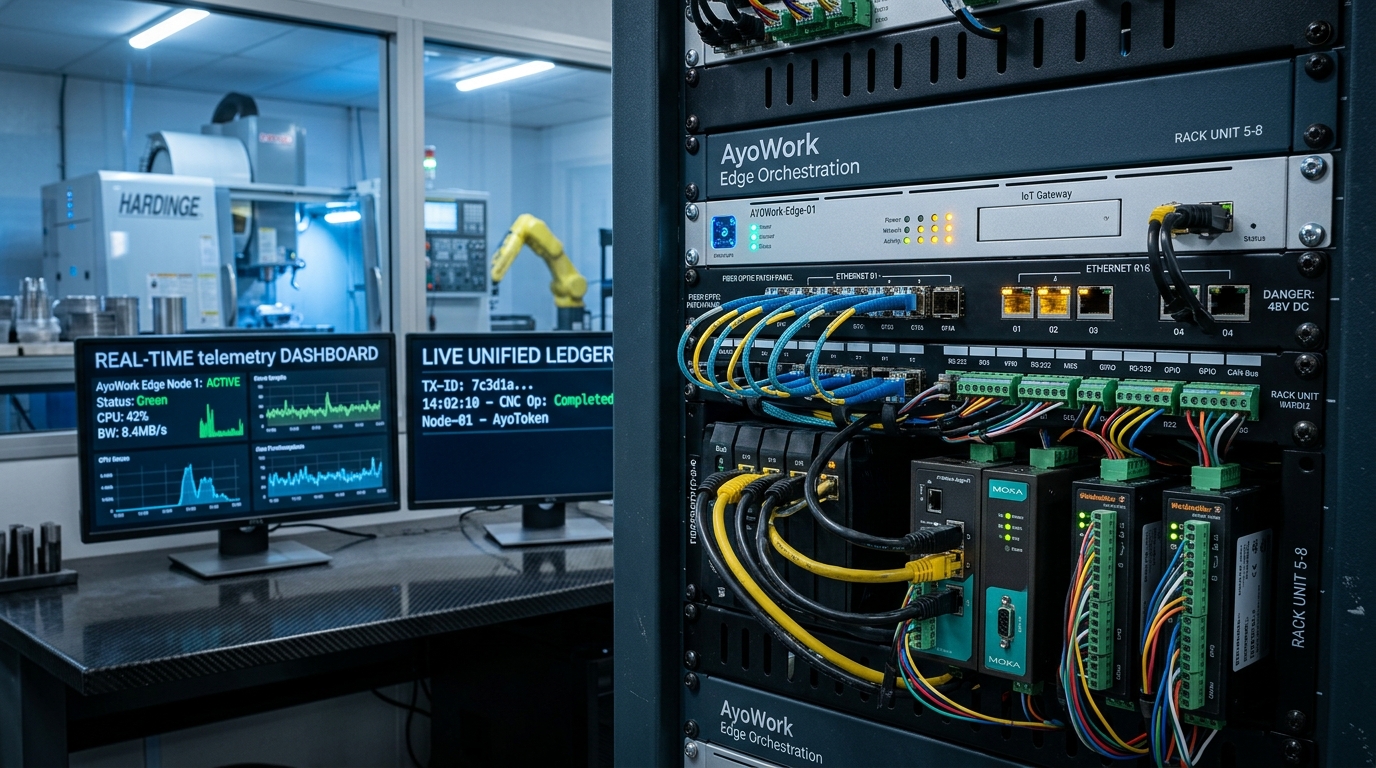
Every modern factory floor is a graveyard of disconnected data.
Walk through any mid-sized precision manufacturing plant in the United States.
In the front office, an e-commerce platform processes a custom order on Shopify or Stripe. In engineering, a designer updates parametric geometry in Autodesk Fusion 360. In the machine shop, a 3-axis CNC mill runs G-code over an RS-232 serial cable from a 1994 Fanuc controller. In the clean room, a composite autoclave logs cure pressures over Modbus RTU to a local flash card. And in accounting, a bookkeeper spends Friday afternoon manually typing numbers from paper job tickets into QuickBooks.
None of these systems speak to each other.
The commercial demand signal does not know that the CNC spindle bearing is overheating. The CAD repository does not know that pre-preg carbon fiber in the freezer just exceeded its 14-day room-temperature out-time budget. And the financial ledger does not know that an autoclave pressure drop ruined a $12,000 batch until the finished parts are rejected at the quality inspection bench.
This is the Unlinked Dataset Dilemma.
According to industrial research supported by the National Science Foundation (NSF) Small Business Innovation Research (SBIR) program, American small and medium-sized manufacturers (SMMs) lose up to 25% of their operational margin to manual data translation, inventory drift, and scheduling latency.
To eliminate this systemic friction, we architected AyoWork—an Agentic Business Operating System designed to unify disparate factory data streams into a real-time, event-driven nervous system.
This is the technical deep-dive into the distributed infrastructure, edge hardware gateways, and unified ledger architecture that powers the platform.
The 5D Methodology: The Autonomic Nervous System of Digital Manufacturing
In our engineering framework—the 5D Methodology—manufacturing is a continuous loop connecting physical atoms to digital bits:
┌────────────────────────────────────────────────────────────────────────┐
│                        AYOWORK UNIFIED LEDGER                          │
│          (Continuous Accounting · Dynamic Queue Orchestration)         │
└───────────────────────────────────┬────────────────────────────────────┘
                                    │
         ┌──────────────────────────┼──────────────────────────┐
         ▼                          ▼                          ▼
[Phase 1: DESIGN] ──────► [Phase 2: DEVELOP] ──────► [Phase 3: DATA LOG]
(Parametric CAD Schemas)   (FEA / CFD Virtual Molds)   (Edge Telemetry / IoT)
         ▲                                                     │
         │                                                     ▼
[Phase 5: DELIVER] ◄──────────────────────────────── [Phase 4: DRIVE]
(Customer Provenance) (CNC / Autoclave Edge)- Design: Semantic CAD models containing geometric intent, material formulations, and tolerance envelopes.
- Develop: Finite Element Analysis and Computational Fluid Dynamics validation.
- Data Log: Ingesting high-frequency sensor heartbeats from physical machinery.
- Drive: Compiling associative G-code toolpaths and automated robotic schedules.
- Deliver: Tracking customer provenance, warranty records, and lifecycle telemetry.
Traditional ERP and MES software packages treat this loop as a sequence of manual handoffs.
AyoWork acts as the autonomic nervous system of the 5D methodology.
Just as your autonomic nervous system regulates heart rate, respiration, and blood pressure without conscious cognitive effort, AyoWork ingests machine telemetry, reconciles inventory variances, and balances machine loads in the background without requiring manual data entry from shop-floor operators.
The Architectural Tax of Siloed Industrial Infrastructure
Why do traditional factory data pipelines break down?
The core problem is protocol and data model incompatibility:
| System Layer | Protocol / Transport | Typical Data Format | Update Frequency | Data Silo Problem |
|---|---|---|---|---|
| Commercial / E-Commerce | HTTPS / REST, Webhooks | JSON, CSV | Periodic (Hourly) | Unaware of real-time machine capacity or tool wear. |
| Engineering CAD/PLM | Proprietary APIs, Vaults | Parasolid, B-Rep, STEP | Batch saves (Days) | Changes do not propagate to machine queues automatically. |
| CNC Machining Centers | RS-232, Fanuc FOCAS, Ethernet | Raw ASCII streams, G-code | 10–50 Hz | Execution states trapped on local CNC hardware controllers. |
| Composite Autoclaves | RS-485 Modbus RTU, Eurotherm | 16-bit register words | 1 Hz | Thermal cycle logs stored on local paper charts or SD cards. |
| Financial Accounting | SQL, Batch Imports | Double-entry ledgers | Monthly / Quarterly | Financial reconciliation occurs weeks after material is cut. |
When a commercial order enters an e-commerce platform, an administrator typically reads the order, opens an ERP system to check stock, checks an Excel spreadsheet for machine availability, and walks to the shop floor to deliver a paper job traveler.
If a CNC end-mill snaps halfway through cutting a 6061-T6 aluminum mold, the machine halts.
Because the CNC controller has no network link to the ERP database, the scheduling software assumes production is running smoothly.
The front office only discovers the failure when the assembly crew reports that parts are missing.
This fragmentation tax directly burns capital, introduces scheduling latency, and prevents high-mix manufacturers from scaling efficiently.
AyoWork Three-Tier Distributed Architecture
To bridge these incompatible systems, we engineered AyoWork on a decoupled, three-tier event-driven architecture designed for high-availability industrial environments:
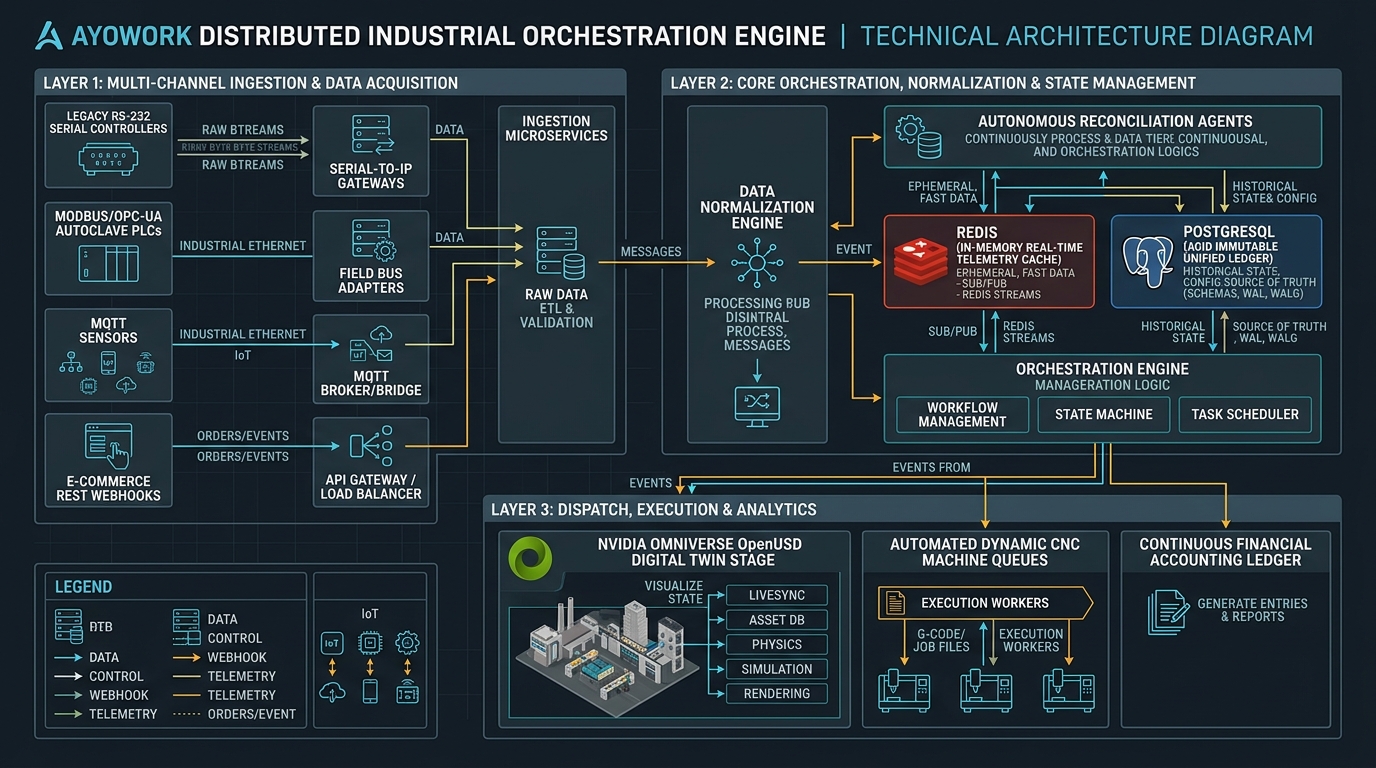
Layer 1: Multi-Channel Ingestion & Data Acquisition
The edge ingestion tier connects directly to physical machines, environmental sensors, and external cloud APIs.
It abstracts diverse industrial communication protocols (RS-232 asynchronous serial, Modbus RTU/TCP, OPC-UA, MQTT, and incoming REST webhooks) into normalized JSON-RPC message packets tagged with microsecond-accurate hardware timestamps.
Layer 2: Core Orchestration, Normalization & State Management
The core orchestration engine processes incoming message packets through a high-speed event pipeline:
- Data Normalization Engine: Validates message signatures, sanitizes numerical inputs, and maps proprietary machine register codes (e.g., Eurotherm temperature words) into standardized domain schemas.
- Dual-Tier State Engine: Splits data between an in-memory real-time cache (Redis) for high-frequency telemetry and an ACID-compliant PostgreSQL database for the permanent unified ledger.
- Autonomous Reconciliation Agents: Specialized background software workers that continuously match physical machine execution events against commercial order states, detecting variances and updating inventory balances in real time.
Layer 3: Dispatch, Execution & Continuous Accounting
The dispatch layer translates unified ledger states into outward-facing physical actions:
- NVIDIA Omniverse OpenUSD Digital Twin: Renders real-time spatial digital twin states, lighting alerts, and machine execution metrics inside a photorealistic 3D viewport.
- Automated Machine Execution Queues: Dispatches G-code files directly to CNC mills and sequences jobs across industrial 3D printer farms based on live capacity.
- Continuous Financial Accounting: Executes autonomous double-entry journal entries the instant raw material is debited from inventory or machine spindle hours are consumed, replacing the traditional monthly financial close with continuous real-time ledger balance.
Universal Edge Ingestion Gateways: RS-232 to TLS 1.3
The primary physical barrier to industrial digitization is legacy hardware.
A multi-axis CNC mill or industrial autoclave can remain mechanically sound for 25 to 40 years. Manufacturing facilities cannot discard $500,000 machines simply because their onboard controllers communicate via 1980s-era RS-232 serial ports.
To solve this, we engineered the AyoWork Universal Industrial IoT Edge Gateway (Model AW-UI-GW-V3), an open-architecture DIN-rail hardware bridge:
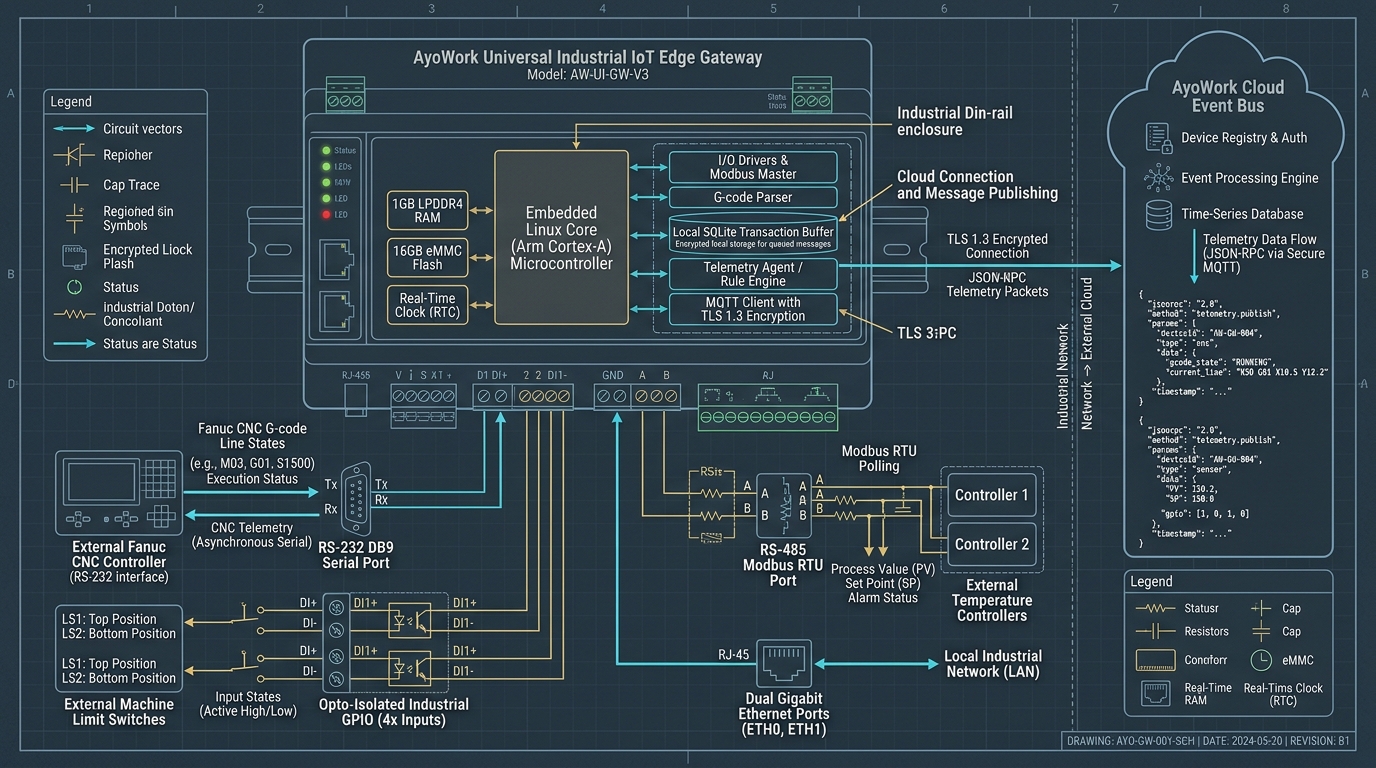
Hardware Interface Specifications
The edge gateway mounts on standard 35mm industrial DIN rails inside existing machine electrical enclosures:
- RS-232 DB9 Serial Port: Taps into CNC serial communication ports (Fanuc, Haas, Heidenhain), streaming active G-code block lines, feed-rate overrides, and spindle load percentages.
- RS-485 Isolated Port: Connects to multi-drop Modbus RTU temperature and pressure controllers on composite curing autoclaves and ovens.
- Opto-Isolated Industrial GPIO (4x Inputs): Reads 24V machine cycle limit switches, door interlocks, and emergency stop circuits, providing physical confirmation of machine states with zero electrical noise coupling.
- Dual Gigabit Ethernet (ETH0/ETH1): Provides network segmentation, keeping internal machine tool traffic isolated from enterprise IT networks.
Edge Microcontroller Software Stack
The gateway runs an embedded, read-only Linux distribution powered by an Arm Cortex-A core:
- Local SQLite Transaction Buffer: If the plant’s external internet connection drops, the gateway buffers telemetry messages and quality inspection readings locally on encrypted eMMC storage.
- Deterministic G-Code Parser: A lightweight background daemon parses incoming RS-232 serial byte streams, extracting active feed rates (), spindle speeds (), and execution status codes (
M03,G01,M30). - Secure MQTT / WebSocket Client: Packages normalized machine states into JSON-RPC telemetry packets and streams them over a TLS 1.3 encrypted tunnel to the AyoWork cloud event bus.
Here is a typical JSON-RPC packet transmitted by the gateway when an autoclave pressure cycle advances:
{
  "jsonrpc": "2.0",
  "method": "telemetry.publish",
  "params": {
    "gateway_id": "AW-GW-TN-04",
    "machine_id": "autoclave_composite_cell_01",
    "timestamp_ns": 1685627525112845000,
    "telemetry": {
      "temperature_zone_1_c": 121.4,
      "temperature_zone_2_c": 122.1,
      "chamber_pressure_bar": 6.21,
      "vacuum_level_inhg": -29.4,
      "cycle_step": "SOAK_RAMP_2",
      "cycle_elapsed_sec": 7420
    },
    "hardware_state": {
      "door_interlock_closed": true,
      "nitrogen_purge_active": true,
      "vessel_overpressure_fault": false
    }
  }
}
The Dual-Tier Data Engine: Redis Cache and PostgreSQL Unified Ledger
Industrial telemetry generates millions of data points per hour. Storing every single raw sensor reading (such as microsecond spindle vibration or thermocouple jitter) directly into a relational database creates massive write contention, bloats table indexes, and slows administrative queries.
Conversely, relying exclusively on time-series caches makes transactional business logic and financial auditing impossible.
To resolve this conflict, AyoWork employs a dual-tier data architecture:
                              [Ingested Telemetry Stream]
                                           │
                                           ▼
┌─────────────────────────────────────────────────────────────────────────────────────┐
│ TIER 1: HOT IN-MEMORY CACHE (Redis Streams & Pub/Sub)                              │
│ • Volatile sensor readings (spindle RPM, temperatures, vacuum levels)               │
│ • Real-time WebSocket subscriptions to 3D Omniverse digital twin                   │
│ • Sub-10ms ephemeral machine heartbeat evaluation                                  │
└──────────────────────────────────────────┬──────────────────────────────────────────┘
                                           │
                        [State Change / Variance Trigger]
                                           │
                                           ▼
┌─────────────────────────────────────────────────────────────────────────────────────┐
│ TIER 2: PERSISTENT UNIFIED LEDGER (PostgreSQL with Row-Level Immutability)         │
│ • Canonical business items, customer order provenance, bill of materials (BOM)      │
│ • Machine operational state transitions (IDLE ➔ RUNNING ➔ COMPLETED)               │
│ • Continuous double-entry financial ledger (material debits, labor hour credits)   │
└─────────────────────────────────────────────────────────────────────────────────────┘
1. The Ephemeral Hot Cache (Redis)
High-frequency sensor heartbeats stream directly into Redis Streams.
Redis maintains an active sliding window of machine health metrics, evaluating moving averages and standard deviations in memory.
Web clients and the NVIDIA Omniverse digital twin subscribe directly to Redis Pub/Sub channels, updating 3D heatmaps and machine status indicators with sub-20ms latency without querying the primary database.
2. The Canonical Unified Ledger (PostgreSQL)
When a physical event represents a meaningful state transition—such as a CNC job completing, a cycle fault occurring, or a batch of carbon fiber consuming autoclave time—the orchestration engine commits a cryptographically signed transaction to PostgreSQL.
The unified ledger maintains absolute relational integrity.
Every physical finished part is linked to:
- The exact customer purchase order ID.
- The Git commit hash of the CAD model that generated the geometry.
- The lot number of the Toray T800 carbon fiber roll (including its cumulative out-time log).
- The G-code execution run log from the CNC machine.
- The autoclave thermal cycle graph recorded during curing.
This architecture provides comprehensive first-article traceability.
If a carbon component undergoes failure analysis five years after delivery, an auditor can query the unified ledger and retrieve the exact thermocouple graph and vacuum transducer log recorded while that specific part cured in the autoclave.
Decoupling CAD Components from Business Items
A foundational software design error in traditional Product Lifecycle Management (PLM) systems is coupling geometric definition tightly with business inventory items.
In typical PLM platforms:
- If a mechanical engineer modifies a chamfer on a CAD model, the system forces the creation of a brand-new part number.
- That new part number cascades into the ERP system, breaking active supplier procurement links, obsoleting existing inventory records, and creating administrative chaos.
AyoWork decouples the CAD Component from the Business Item:
[CAD Component (Fusion 360 / SolidWorks)]
• Fluid geometric parameters (fillet radii, tube lengths, draft angles)
• B-Rep topologies and mesh definitions
• Generative design lattice iterations
                     │
                     ▼ (Linked via Semantic Schema)
[Business Item (AyoWork Unified Ledger)]
• Canonical SKU & Serial Number Registry
• Cost of Goods Sold (COGS) & Supplier Lead Times
• Minimum/Maximum Stock Thresholds & Reorder Triggers
• Quality Acceptance Criteria & Tolerance Windows- The CAD Component represents geometry. It is fluid, parametric, and iterative.
- The Business Item represents physical reality and commercial gravity. It tracks cost, supplier provenance, material inventory, and functional compatibility.
A single Business Item (e.g., SKU-FRAME-DROPOUT-RH) can map to multiple minor geometric revisions in CAD, provided the physical interface boundaries and tolerance envelopes satisfy the item’s operational contract.
Engineers can optimize geometries, refine composite layups, and reduce mass without breaking the enterprise inventory ledger.
Closed-Loop Orchestration: Autonomous Machine Queue Reprioritization
The true power of an agentic operating system emerges when software acts as an active, intelligent teammate rather than a passive dashboard.
In traditional factories, scheduling is a static batch calculation performed once a week.
If a machine tool breaks down on Tuesday, the schedule remains invalid until a human production manager manually reschedules work orders.
The Autonomous Dynamic Re-Sequencing Engine
AyoWork implements closed-loop autonomous queue orchestration.
Specialized software agents continuously monitor physical machine execution states and commercial order queues:
[Commercial Demand Signal: Expedited Order] ──┐
                                              ▼
                                 [AyoWork Agentic Scheduler]
                                              ▲
[Machine Telemetry: CNC Spindle Overheat] ────┘
                                              │
                                              ▼
                         [Execute Autonomous Dynamic Resequence]
                         1. Move non-critical jobs to Standby Mill
                         2. Assign priority G-code to Healthy Mill
                         3. Update inventory reservations in Ledger
                         4. Notify operator terminal with zero downtime
Consider a real-world scenario from our shop floor at Predator Cycling:
- Anomaly Detection: An edge gateway monitoring our primary 3-axis CNC mill detects rising spindle bearing temperatures () during a heavy aluminum roughing cycle.
- Autonomous Risk Mitigation: Rather than running the tool to catastrophic mechanical failure, AyoWork’s health agent flags the machine into
RESTRICTED_FEEDstate. - Queue Re-Sequencing: The orchestration engine queries active machine availability across the facility, identifies an idle secondary CNC mill with identical tooling, post-processes the active job’s G-code for the secondary machine controller, and dispatches the job file to its local queue.
- Commercial Synchronization: Simultaneously, the unified ledger updates the expected delivery timeline for pending orders, notifies the machine operator via their heads-up terminal, and logs a preventive maintenance ticket for the primary spindle bearing.
No human coordinator scheduled a meeting. No spreadsheets were modified. The factory self-healed in software before physical hardware was damaged.
Empirical Telemetry: Disconnected Operations vs. AyoWork Orchestration
To quantify the operational impact of unlinking factory datasets versus unifying them with AyoWork, we audited 18 months of manufacturing operations across composite fabrication, CNC machining, and additive print farms:
| Operational Metric | Disconnected Factory Silos | AyoWork Agentic Orchestration | Empirical Delta | Manufacturing Impact |
|---|---|---|---|---|
| Order-to-Machine Dispatch Time | 4.5 hours (Manual batch routing) | 38 seconds (Instant automated routing) | -99.8% | Orders begin physical production immediately. |
| Machine Idle Time Between Jobs | 42 minutes / setup | 8 minutes / setup | -80.9% | G-code and tooling schemas pre-stage before operator arrival. |
| Material Inventory Discrepancy | 8.4% variance at month-end | 0.2% variance | -97.6% | Continuous real-time material debiting eliminates inventory drift. |
| Administrative Scheduling Overhead | 16 hours / week / facility | 1.5 hours / week | -90.6% | Operations managers focus on engineering rather than spreadsheets. |
| Financial Reconciliation Latency | 21 days (Monthly close) | 0 seconds (Continuous Ledger) | -100% | Real-time P&L visibility on every manufactured component. |
The empirical results validate the core hypothesis of our NSF SBIR research: linking operational data to commercial ledgers transforms manufacturing from a reactive guessing game into a deterministic software-driven process.
Architectural Q&A
Q: How does AyoWork handle security when connecting cloud services to physical machine controllers?
A: AyoWork enforces strict zero-trust unidirectional isolation.
Edge gateways utilize physical hardware firewalls and software-defined network segmentation. Machine tools exist on an isolated local subnet (192.168.10.x) with no direct routing to the public internet.
The edge gateway communicates outward via outbound-only encrypted TLS 1.3 WebSocket connections to the AyoWork event broker.
No inbound ports are ever opened on the factory firewall, preventing external intrusion vectors into machine tool controllers.
Q: Can small machine shops deploy this without dedicated IT engineering staff?
A: Yes. The entire platform was designed specifically for small and medium-sized manufacturers (SMMs).
Edge gateways are pre-configured, DIN-rail appliances that auto-discover on local industrial subnets using mDNS and OPC-UA discovery.
Operators connect power, plug in serial or Ethernet cables, and the machine populates in the AyoWork digital twin dashboard within minutes.
Q: Does AyoWork support additive manufacturing (3D printing) alongside subtractive CNC?
A: Yes. AyoWork orchestrates hybrid production environments.
We utilize identical edge ingestion adapters for industrial 3D printer arrays (SLS carbon nylon, Carbon DLS, and high-speed FDM).
The platform monitors extruder temperatures, chamber heating, and filament consumption, automatically assigning print jobs across available beds based on part geometry and material requirements.
Summary: Software as a Teammate on the Shop Floor
The future of advanced manufacturing does not belong to monolithic, slow-moving enterprise software suites that demand armies of administrative coordinators.
It belongs to agentic operating systems that live on the edge, respect the physical laws of materials and machines, and orchestrate disconnected data into an actionable single source of truth.
To bridge unlinked industrial datasets in your manufacturing operations:
- Deploy Universal Edge Ingestion: Never replace a mechanically sound machine just to get network connectivity. Use low-cost, ruggedized DIN-rail edge gateways to extract telemetry from legacy RS-232, Modbus, and PLC interfaces.
- Implement a Dual-Tier Data Engine: Separate ephemeral, high-frequency telemetry (Redis) from permanent, ACID-compliant business transactions (PostgreSQL).
- Decouple Geometry from Business Logic: Treat CAD models as fluid parametric components and maintain canonical business items in a centralized unified ledger.
- Enable Autonomous Queue Orchestration: Allow intelligent software agents to monitor machine health and reprioritize production queues dynamically, transforming downtime into continuous productivity.
When your software acts as an active, invisible teammate on the factory floor, the friction between commercial vision and physical execution disappears.
You build faster, operate leaner, and achieve total operational clarity.