Engineering Pedagogy: Codifying Shop-Floor Physics for Enterprise Scale
How we codified 15 years of artisan composite fabrication and parametric CAD into scalable LinkedIn Learning courses for global enterprise engineering teams.
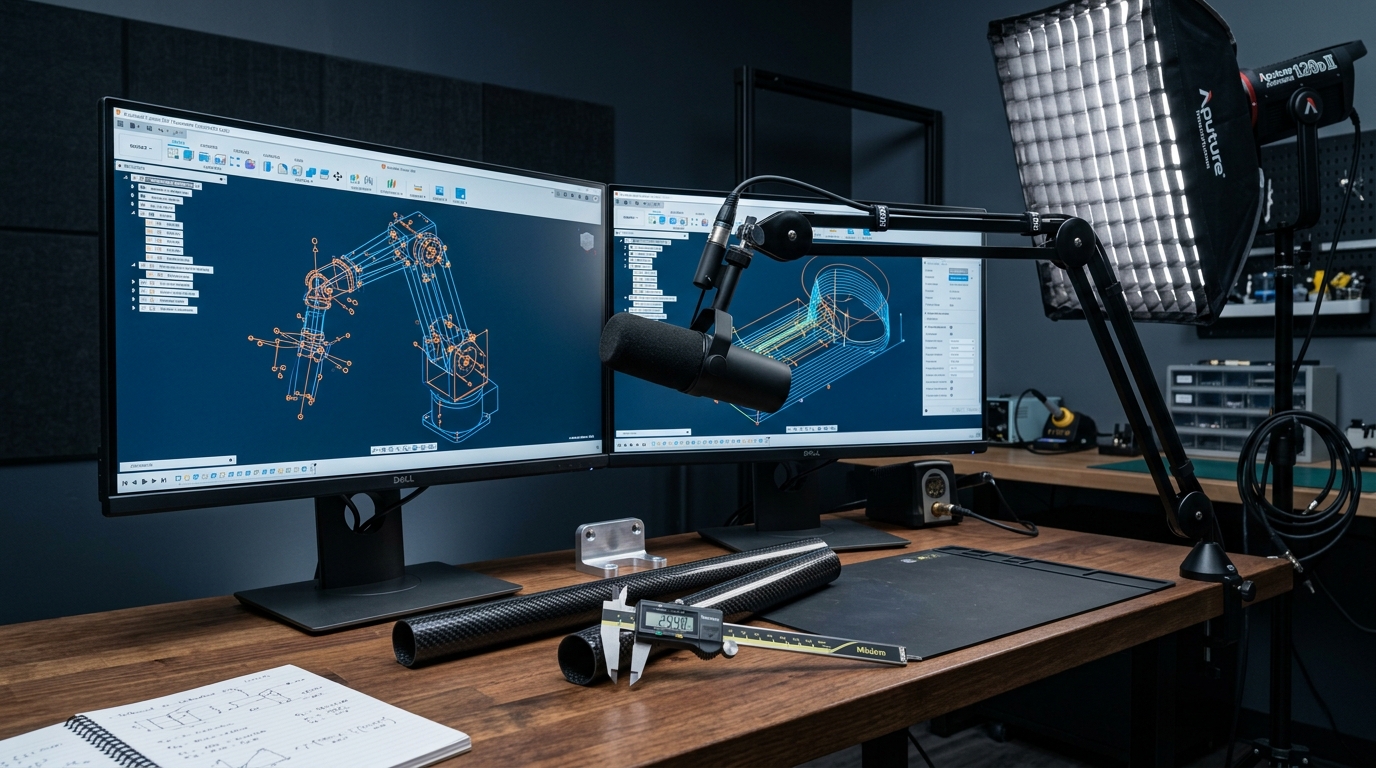
There is a massive, quiet crisis in modern hardware engineering: the chasm between academic theory and shop-floor reality.
Every year, universities graduate thousands of brilliant mechanical engineers who can derive Navier-Stokes equations by hand, calculate tensor strain transformations, and solve complex differential equations on an exam.
Yet, when you hand that same graduate a roll of aerospace pre-preg carbon fiber or ask them to program a toolpath for a multi-axis CNC mill, they freeze.
They have never felt the chemical tack of an epoxy resin system at room temperature. They don’t know why a sharp inner corner with a 1 mm radius causes dry-fiber bridging during vacuum consolidation. They don’t understand why an unconstrained bottom-up CAD assembly explodes the moment you adjust a single mounting hole diameter.
In 2020, when LinkedIn Learning approached our team at Predator Cycling to author comprehensive video courses on Autodesk Fusion 360, Generative Design, and Advanced Composite Tooling, our mission was simple:
Dismantle the academic ivory tower and codify 15 years of visceral, hands-on manufacturing physics into structured, scalable digital curriculum.
Grounded in our 5D Manufacturing Methodology, we took the unwritten tribal knowledge of master composite builders and translated it into modular, repeatable frameworks for tens of thousands of working engineers across aerospace, automotive, and consumer hardware.
Here is the engineering pedagogy of how we teach top-down parametric modeling, bridge computational bits with shop-floor atoms, and scale institutional knowledge across global organizations.
The Academic Reality Gap: Why Degrees Fail the Shop Floor
Traditional engineering education teaches physics in an idealized vacuum. Formulas assume isotropic metals, frictionless surfaces, and infinitely rigid fixtures.
In practical manufacturing, nothing is isotropic, everything deflects, and thermal expansion will ruin your day.
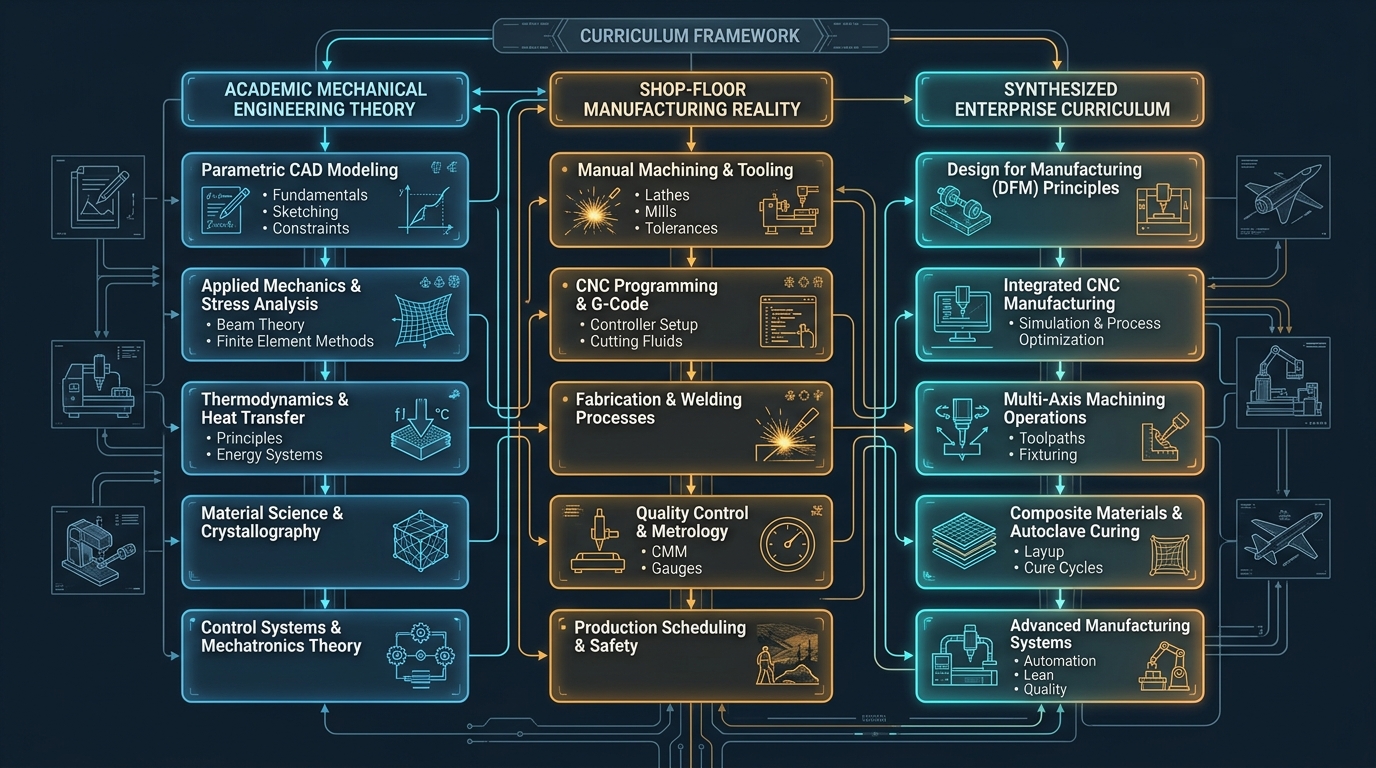
When young engineers design parts purely in software without shop-floor grounding, they design for the screen, not the machine:
- Tool Access Blindness: Modeling deep, narrow pockets that require a 0.125” end mill with a 4-inch stick-out, guaranteeing violent tool chatter and broken cutters.
- Tolerance Stacking Ignorance: Specifying tolerances on unmachined composite surfaces that move simply from ambient humidity and post-cure shrinkage.
- CAD Fragility: Assembling 200 components using point-to-point mate constraints. The first time a client asks for a 10 mm wheelbase extension, 40 downstream mates fail with red error warnings, forcing a complete model rebuild.
To fix this, technical education must shift from rote procedural memorization (“click this button, then click that icon”) to first-principles mental models.
Pedagogical Compression: Translating 15 Years into 4-Minute Modules
Teaching an artisan craft to a camera lens is harder than building the physical part.
When you fabricate a carbon fiber monocoque track frame in our shop, your hands process hundreds of real-time analog sensory inputs:
- The auditory feedback of a rotary air tool biting into cured epoxy.
- The thermal sensation of an aluminum mold heating up too fast during an exothermic cure.
- The tactile resistance of pre-preg tape stretching over an organic compound curve.
On a digital video platform like LinkedIn Learning, you have none of those physical senses. You have a screen recording, a microphone, and an audience of engineers whose attention spans are measured in seconds.
Pedagogical Compression Pipeline:
[15 Years Shop-Floor Intuition]
       │
       ▼ (Root-Cause Extraction)
[First-Principles Physical Law]
       │
       ▼ (Screen Capture Demonstration)
[Live CAD/CAM Execution: 3 to 5 Minutes]
       │
       ▼ (Immediate Failure & Recovery)
[Intentional Error Injection: Showing how to debug when the model breaks]
The Rule of the 5-Minute Module
We developed a strict curriculum rule: Every single video module must solve exactly one physical problem in under 5 minutes.
- State the Physical Problem: “If you run an undercut on a two-piece split mold, your $5,000 composite part will lock inside the aluminum block forever.”
- Expose the Math/Geometry: Demonstrate draft angle analysis in CAD, highlighting the zero-draft boundary line.
- Execute the Solution: Add a draft angle using the parting plane as a neutral reference.
- Intentionally Break the Model: Change a parameter to demonstrate what a negative draft undercut looks like, show the warning signs, and fix it live.
Engineers don’t learn from pristine, frictionless tutorials where everything works on the first try. They learn from watching an expert make an intentional mistake, diagnose the geometric or physical root cause, and systematically resolve it.
The Top-Down Master Skeleton Architecture
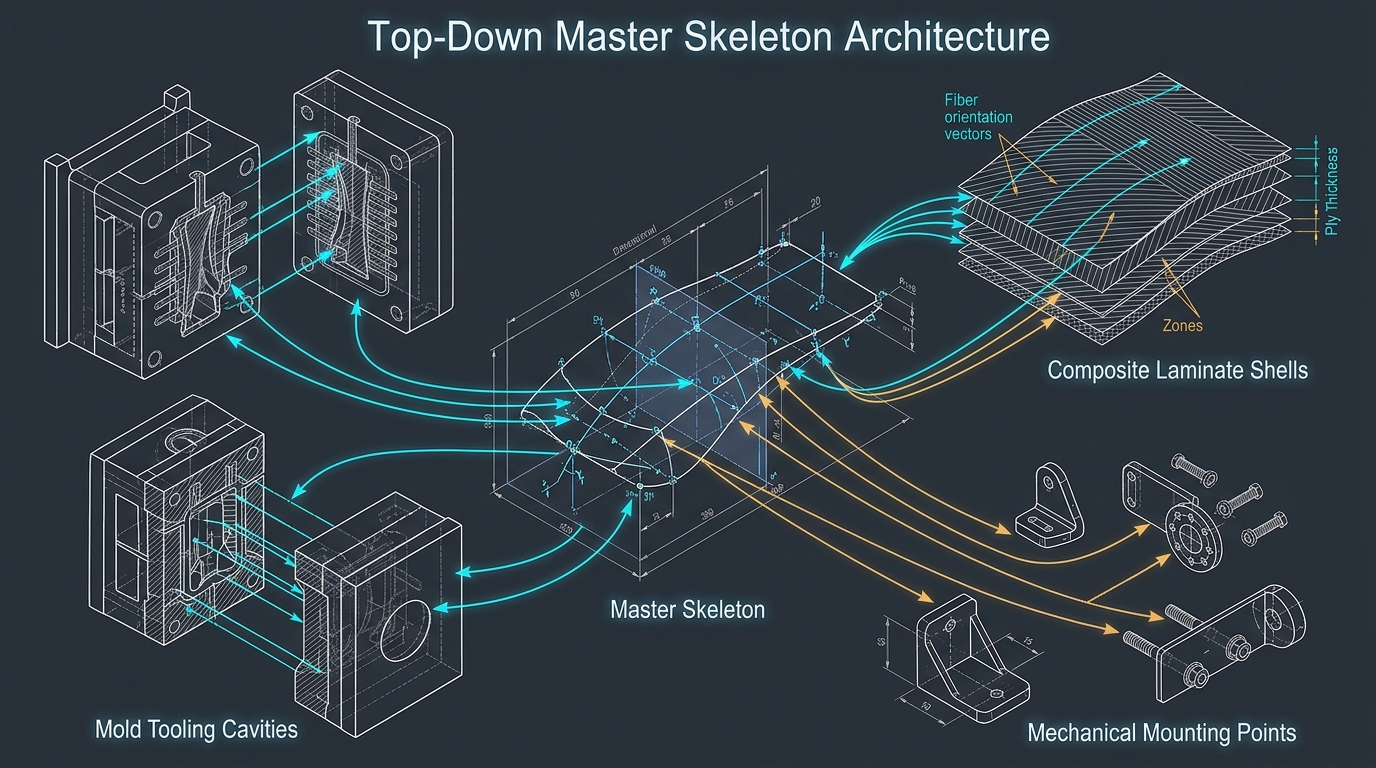
The cornerstone of our CAD pedagogy—taught across our courses and showcased at Autodesk University—is the Top-Down Master Skeleton Architecture.
Most self-taught CAD users design “bottom-up”: they model Part A, model Part B, drop them into an assembly file, and glue them together with geometric mates.
Bottom-up modeling is a trap. In complex assemblies like an aerodynamic bicycle, an electric vehicle chassis, or an industrial automation gantry, a single revision ripples across dozens of mating surfaces.
How Master Skeleton Modeling Works
Instead of modeling solid components in isolation, the entire mechanical system is driven by a single, un-extruded Master Skeleton Sketch:
- The Single Source of Truth: The skeleton contains the primary 2D and 3D reference axes, key geometric intersections, centerline paths, and global dimensional parameters (
Wheelbase,Rake,Clearance,Driver_Offset). - Downstream Derivation:
- The Structural Composite Shell references the skeleton to define outer aerodynamic surfaces.
- The Aluminum Mold Tooling Block references the exact same skeleton to determine parting lines and dowel pin locations.
- The Internal Bladder Mandrel references the skeleton to compute internal cavity offsets.
- Parametric Immunity:
When the lead engineer alters
Wheelbasefrom 980 mm to 1,005 mm in the global parameter table, not a single mate breaks. The master skeleton stretches. The structural shell follows. The mold cavity geometry recalculates. The CNC toolpaths update automatically.
Teaching this architectural mental model transforms students from “CAD operators” who push polygons into systems architects who build scalable, parametric engineering platforms.
Demystifying Composite Physics for Digital Native Engineers
Composites are fundamentally different from metals. Steel and aluminum are isotropic—their molecular crystalline lattice responds identically regardless of the load direction.
Carbon fiber is anisotropic and orthotropic. It has immense tensile strength along the longitudinal fiber tow (), but virtually zero strength across the transverse resin matrix ().
In our curriculum, we codified the four foundational pillars of composite DFM:
The Four Pillars of Composite DFM:
1. Fiber Orientation Vectoring:
   - 0° Plies: Resist pure axial tension and bending moments.
   - ±45° Plies: Absorb torsional shear and cross-bracing twist.
   - 90° Plies: Resist radial hoop stress and clamp crush.

2. Out-Life and Resin Chemistry:
   - Pre-preg is a living chemical system: B-stage epoxy stored at -18°C.
   - Room-temperature "tack" enables compaction without air entrapment.
   - Exceeding out-life (typically 30 days) causes resin starvation and porosity.

3. Compaction Physics:
   - Atmospheric vacuum (-28 inHg) provides ~14.7 PSI of hydrostatic pressure.
   - High-performance structures demand 100+ PSI internal bladder expansion.
   - Trapped volatile outgases must have clear bleeder escape channels.

4. Exothermic Thermal Management:
   - Epoxy cross-linking is an exothermic reaction.
   - Curing thick laminates (> 8 mm) too rapidly triggers thermal runaway:
     core temperatures spike beyond 200°C, scorching resin and boiling voids.
By teaching engineers to visualize the physical fibers—treating them as tiny structural tension cables floating in a brittle glue matrix—we demystified the black art of composites.
Engineers began designing laminates that aligned fiber vectors directly with the finite element stress trajectories they visualized in Ansys Mechanical and Discovery.
Institutional Memory: Killing the “Tribal Knowledge” Trap
The greatest organizational danger in hardware manufacturing is tribal knowledge.
In almost every boutique fabrication shop or enterprise plant, there is a legendary senior machinist or composite laminator named Dave.
- Dave knows that CNC Mill 3 cuts 0.002” high when the shop gets warm in the afternoon.
- Dave knows that you have to let the bottom bracket mold soak at for an extra 15 minutes or the resin won’t wet out.
- Dave has all this knowledge locked inside his head.
When Dave retires, gets sick, or leaves for a competitor, the company loses its core manufacturing capability.
The Tribal Knowledge Vulnerability:
[Senior Artisan's Intuition] ──► Locked in Head ──► Employee Leaves ──► Catastrophic Scrap Spikes

The Codified Pedagogical Pipeline:
[Shop-Floor Insights] ──► [Digital Video Modules + Parametric CAD Templates] ──► [Scalable Enterprise Asset]
By partnering with platforms like LinkedIn Learning and building our own internal training repositories, we proved that artisan hardware manufacturing can be codified.
When you capture the physics of setup, fixturing, machining, and curing in high-definition video coupled with live parametric CAD files, you transform artisan intuition into repeatable, scalable institutional capital.
New technicians can onboard in days instead of years. Distributed engineering teams in California, Detroit, and Munich can operate from the exact same design rules, eliminating scrap rates and bridging the handoff from digital CAD to physical hardware.
Summary: Core Pedagogical Principles
- Teach the physics, not the software interface: Software menus change with every release; the laws of thermodynamics, chip thinning, and fiber shear are eternal.
- Deconstruct complex skills into 5-minute modules: State the physical problem, expose the geometric constraint, demonstrate the solution, and intentionally break the model to teach diagnostic recovery.
- Enforce top-down master skeletons: Building assemblies around a single parametric wireframe skeleton eliminates fragile mate constraints and makes models immune to parametric revision crashes.
- Treat composites as living chemical systems: Anisotropic laminates demand that designers visualize fiber orientation vectors, resin out-life, and exothermic cure kinetics during CAD geometry creation.
- Codify tribal knowledge into enterprise assets: Documenting shop-floor techniques into structured digital curricula protects organizations from institutional memory loss and accelerates engineering onboarding.
Technical Q&A
Q1: Why do you recommend top-down skeleton modeling over standard multi-body modeling in Fusion 360?
A: Scalability and downstream derivation. While multi-body modeling inside a single part file works well for simple objects, it quickly becomes unmanageable as design complexity grows. Top-down skeleton architecture allows you to derive the master wireframe into completely separate component files (e.g., one engineer works on the aluminum mold tooling while another designs the internal composite laminate). Both files remain dynamically linked to the master skeleton without file locking or performance bloat.
Q2: What is the most common mistake engineers make when transitioning from metal to composite CAD?
A: Designing uniform wall thicknesses and sharp inside radii. In cast or machined metals, uniform thickness is standard practice. In composites, stress concentrations dictate that you vary laminate thickness dynamically—stacking 40 plies around a bottom bracket junction while tapering down to 8 plies along the mid-span of a tube. Furthermore, sharp inside corners () cause pre-preg carbon plies to bridge across the fillet rather than conforming, leaving structural voids and resin-rich pockets.
Q3: How do you measure the effectiveness of an enterprise engineering curriculum?
A: Real-world scrap reduction, revision velocity, and first-pass yield. Effective technical training is not measured by video completion badges. It is measured on the shop floor: Did engineering change orders (ECOs) drop? Did the time required to re-size a parametric assembly shrink from two weeks to two hours? Did the machine shop report fewer tool breakages due to improper DFM clearances? When curriculum reflects shop-floor physics, engineering throughput climbs immediately.
Next Step: Connect and Discuss
Engineering education and technical knowledge codification are the foundation of scalable digital manufacturing.
- Read our foundational methodology: The 5D Manufacturing Framework.
- Explore our manufacturing case studies in Projects & Ventures.
- Connect with Aram Goganian on LinkedIn to discuss engineering pedagogy, curriculum architecture, parametric CAD systems, and advanced composite manufacturing.